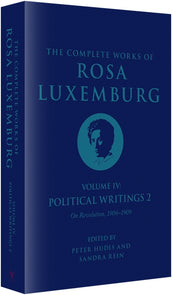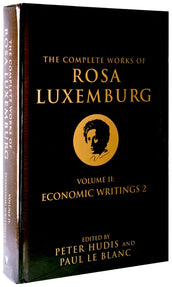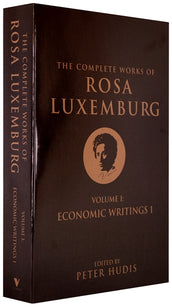
Rosa Luxemburg

Rosa Luxemburg (1871-1919) was a Polish-born Jewish revolutionary and one of the greatest theoretical minds of the European socialist movement. An activist in Germany and Poland, the author of numerous classic works, she participated in the founding of the German Communist Party and the Spartacist insurrection in Berlin in 1919. She was assassinated in January of that year and has become a hero of socialist, communist and feminist movements around the world.

Blog

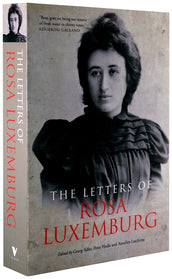
"The indomitable thirst for social justice:" Vladislav Davidzon reviews The Letters of Rosa Luxemburg for Rain Taxi Review of Books

Over at the Rain Taxi Review of Books, Vladislav Davidzon has written an excellent review of The Letters of Rosa Luxemburg, providing a valuable historical overview and evaluation of her frequently overlooked importance—in the Anglo-American world, at least—to the political struggles and development of socialist thought in the early 20th century. Davidzon's review delves both into her extraordinary life as well as into the world-changing historical events that influenced it and which are mirrored afresh through her correspondence and most personal insights. He writes, 

Continue Reading

Comments on 'What more could we want of ourselves!', Jacqueline Rose’s review of The Letters of Rosa Luxemburg

Peter Hudis, an editor of The Letters of Rosa Luxemburg, responds to 'What more could we want of ourselves!', Jacqueline Rose's review of the book in the London Review of Books (June 16, 2011).

One sign of the multidimensionality of Rosa Luxemburg's life and work is the way she appeals to thinkers and activists coming from a number of different directions. Some view her primarily as a brilliant economist, who wrote the first study (at least since Marx's Capital) of capitalism's inherent drive for global expansion. Others view her mainly as a path-breaking political thinker, because of her embrace of spontaneous forms of revolt and her searing critique of those who fail to grasp the centrality of mass participation and democracy in efforts at social revolution. Others are drawn to her largely because of her striking personality, which exhibited a fiercely independent spirit and a fascination with both the beauty and tragedy of the human and natural world. The great merit of Jacqueline Rose's review of The Letters of Rosa Luxemburg is that it focuses on what connects the many strands of Luxemburg's legacy—her profound appreciation of the transformative power of the human intellect.

Continue Reading

Rosa tinted glasses: The Times Literary Supplement and the New Statesman review The Letters of Rosa Luxemburg

Robert Turnbull reviews The Letters of Rosa Luxemburg for the Times Literary Supplement, discussing the book's resonances with contemporary issues:

[The letters] reveal the struggle that Luxemburg undertook to rise to the top of European political life, and the effects of her efforts on her physical and mental health, in an era when women, especially Jewish women, were not expected to play a part in public life ... Luxemburg's correspondence reveals an extraordinary range and breadth of concerns and interests, from her exchanges with numerous European socialist leaders, including Lenin, Leo Jogiches, Clara Zetkin and others, to sharp disputes with her colleagues ... There are contemporary resonances, too. For example, we find Luxemburg writing to Karl Kautsky in 1906 that "the Achilles heel of the movement in St. Petersburg, as it is with us in Poland, the colossal unemployment which is spreading like a terrible plague."

Continue Reading

Books

Discussions

Discussions occur on book pages throughout the site. The most recent discussions about the works of Rosa Luxemburg are listed below.