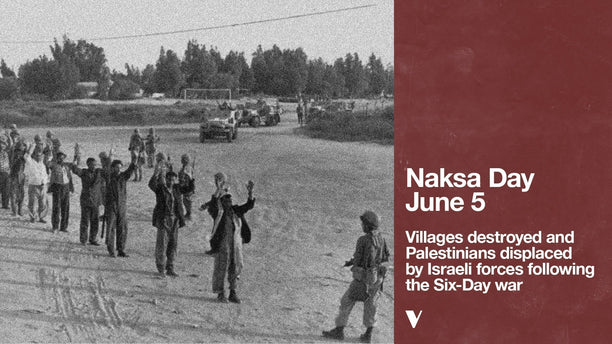
May 15th is Nakba Day - commemorating 64 years since the establishment of Israel and the displacement of hundreds of thousands of Palestinians, many of whom, with their descendants, are still refugees.
To mark Nakba Day, Ceasefire magazine publish two exclusive extracts from The Case For Sanctions Against Israel (also published today).
Hind Awwad, a co-ordinator with the Palestinian BDS National Committee, writes:
As the world watched the Arab Spring, many Palestinians saw traces of Palestine's revolution, particularly of the first Intifada-the popular uprising of 1987—and in the beautiful spirit of the young revolutionaries.
The fall of the regimes in Tunisia and Egypt was celebrated in Palestinian households not only because it promised a return of Arab resistance, a constant dimension of the Palestinian cause but hijacked by the dictatorships for so many years, but also because it was a reminder that Palestine continues to bring people together: those struggling in many places around the world against injustice of all kinds...
The BDS movement has provided a way for us to break our collective chains.
Awwad's piece, BDS: Six Years of Success, goes on to chart some of the many successes of the BDS movement over the last few years. Read the full piece at Ceasefire.
Also published today, esteemed Israeli 'new historian' Ilan Pappe explains why he supports BDS and why he believes that it will work:
The Nakba, or "day of catastrophe," remains the central issue of struggle for the Palestinian people. Commemorated each May 15th, the Nakba began in May 1948 when the State of Israel was founded on Palestinian lands, leading to the forcible expulsion of 75% of the indigenous population. Today, over 5 million Palestinian refugees remain in refugee camps in countries around the world, unable to return to their land and homes. They are the oldest and largest refugee population in the world.
With the announcement, just one day before the Nakba, that Israel has settled with hundreds of Palestinian political prisoners on hunger strike, we reflect on 64 years of Israeli occupation—and Palestinian resistance—with a survey of Verso's responses to this struggle.
On WBAI 99.5 in New York, The Asia Pacific Forum hosted a special two-hour show on the Occupy movement, featuring in-studio interviews with the editors and contributors of Verso's own collection Occupy! Scenes From Occupied America. Discussing everything from what it's like to attend a General Assembly meeting to the larger questions about organized labor and left politics, the show was a valuable occasion for a wide set of reflections on a number of the most pressing issues of the movement.
Among the participants were Astra Taylor and Sarah Resnick, who discussed the genesis of the book; Kung Li, who elaborated about her experience on 'Occupy Atlanta' and considered the role of race in the Occupy movements; Nikil Saval addressed the relationship between trade unions and the possibility for new forms of solidarity with older institutions; and Sarah Leonard spoke about the importance of citizen journalism and the presence and effects of progressive media since the movements first began. As well, Manissa Maharawal discussed the People of Color Caucus, and the show's host, Verso editor and member of the APF Collective, Audrea Lim, discussed her contribution to the collection on gentrification and Chinatown.
Full audio of the interviews is now available online. Please visit the Asia Pacific Forum for a listen.
This roundtable discussion between myself and the editors of Occupy!: Scenes from Occupied America happened over email from December 7-9, 2011. Occupy!, the book, grew out of a forty-page broadsheet called Occupy!: An OWS-Inspired Gazette, put together by the same crew, and distributed at a select number of occupations around the country.
Occupy! editors Astra Taylor, director of the documentary films Zizek! and Examined Life; Keith Gessen, Mark Greif, Nikil Saval, Eli Schmitt and Carla Blumenkranz of the literary journal n+1; and Sarah Resnick, editor of Triple Canopy all participated in the discussion.
How did the Gazette come about?
Astra: Wasn't it Keith's idea? But I like Mark Greif's observation to me that Occupy! is a strange hybrid of my childhood newsletter, Keith Gessen's high school paper, and Sarah Leonard's college paper. I'm sure others made zines and other things too. In other words, we were destined to make the Gazette!
Mark: I think when I tried to explain it to people, I said, "You go home from the park, and you want to read about what you just saw. The Occupiers are doing this incredible thing, and they'll want to read about what they're doing. Maybe we could mirror the park to itself, for the Occupiers and the visitors and the bystanders." To help. Didn't we talk about the fence-sitters too--all the people we knew, who we thought should support what the Occupiers were doing? But they kept coming up with excuses not to come down to the park? Literary and political types. So we would bring the park to them. And it was definitely Keith's idea, the paper.
Nikil: Yep, Keith's idea for sure. I think the other term I kept using (to describe it to people) was "fellow travelers"--i.e. not just undecided people, but ones who wouldn't spend a bunch of time at the park, who nonetheless offered support and wanted to understand what was going on. People ideologically, if not organizationally, committed to OWS. Of which it turns out there are a lot. It was enough that there were people whose brain was like a homologue of the city--just like Zuccotti was always there in some crammed corner way south, your head could be burdened with daily life but still lighted by the obscure sense that the occupation was going on; growing, even.