If 2011 saw a monumental change in the governments of the Middle East, 2012 has demonstrated that revolution takes some time, that conflict is sustained and that some of the same challenges are not consigned to history.
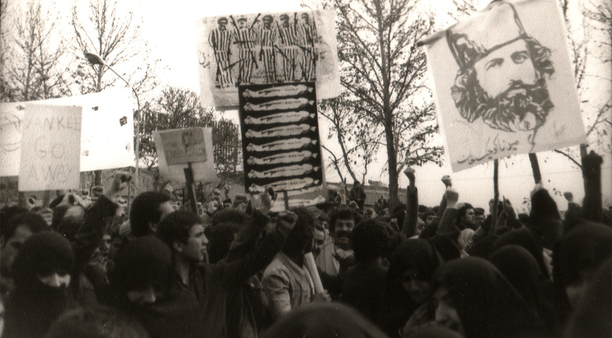
Protests continue in Egypt’s capital Cairo, as over one hundred thousand demonstrators have recently taken to the streets and gathered once again in Tahrir Square in opposition to dictatorial decrees by President Mohammed Morsi. With only one hundred days in power, Morsi’s fledgling tenure as president has resulted in examples of sweeping authority, transferring all executive and legislative powers from the military council to his offices.
Such actions are reminiscent of the power exercised by former President Hosni Mubarak. The on-going distrust of Morsi’s presidency returns the chant of the 2011 revolution: "The people want to bring down the regime".
These are Verso’s key titles on the challenges facing Egypt and the Middle East, where uprising continues from the hopefulness of the Arab Spring to the challenges ahead.
The fall of the Eastern Bloc seemed to spell the end for an alternative to neoliberalism. But the year of unrest that was 2011 gave lie to that notion. The Left is resurgent once again, with writers like Jodi Dean, Slavoj Žižek, and Alain Badiou assiduously attempting to explain the mechanisms behind the mass political movements that occupied streets and plazas in cities like Cairo, Madrid, Athens, and New York.
Alain Badiou’s Rebirth of History: Times of Riots and Uprisings is one of the many attempts to explain the nature of the protests and riots that roiled the world last year. And it has sparked some debate. In their long and detailed critical engagement with the book in the Los Angeles Review of Books, Jasper Bernes and Joshua Clover commend how “ [Badiou] measures the extension of the riot in terms of spread in physical space and across social categories.”
Throughout the review they analyze Badiou's notion of the communist Idea, a theoretical framework that, according to Badiou, lies behind "Los Indignados", Occupy Wall Street, and the occupation of Tahrir Square:
But for those familiar with Badiou’s philosophy and his reliance on logical proof, axiom, and argument from first principles, it will come as no surprise that, for him, communist practice follows behind communist idea. The primacy of the idea is unmistakable in Badiou, not least because it appears in majuscule: “Idea,” rather than “idea.” Glossing his own title early on, he insists that “The only possible reawakening is the popular initiative in which the power of an Idea will take root.”
They also go on to summarize Badiou’s solution for the current crisis of capitalism:
Standing on its head Marx’s statement that “Mankind only sets itself such tasks as it is able to solve,” Badiou writes that “History does not contain within itself a solution to the problems it places on the agenda.” The solution he imagines emerges from beyond history, from the rational process of the Idea and its faithful adherents, who translate the truth of present struggles into winning organizational structures and disciplines.
Visit the Los Angeles Review of Books to read the review in full.
Stuart Jeffries gives an overview of the mainstreaming of Marx in today's Guardian, featuring Verso authors Alain Badiou, Jacques Rancière, Owen Jones and Slavoj Žižek as well as the new edition of The Communist Manifesto.
Class conflict once seemed so straightforward. Marx and Engels wrote in the second best-selling book of all time, The Communist Manifesto: "What the bourgeoisie therefore produces, above all, are its own grave-diggers. Its fall and the victory of the proletariat are equally inevitable."...Today, 164 years after Marx and Engels wrote about grave-diggers, the truth is almost the exact opposite. The proletariat, far from burying capitalism, are keeping it on life support.
Jeffries interviews Jacques Rancière, philosopher, radical social historian (and Ségolène Royal's favourite thinker) to shed light on the 'new Marxism':
Aren't Marx's venerable ideas as useful to us as the hand loom would be to shoring up Apple's reputation for innovation? Isn't the dream of socialist revolution and communist society an irrelevance in 2012? After all, I suggest to Rancière, the bourgeoisie has failed to produce its own gravediggers. Rancière refuses to be downbeat: "The bourgeoisie has learned to make the exploited pay for its crisis and to use them to disarm its adversaries.
In his review for Prospect of The Adventure of French Philosophy by Alain Badiou, Jonathan Rée poses the question as to whether French philosophy is the country’s greatest export. Rée briefly details the rich history of what Badiou calls the “French moment” in contemporary thought. Focusing on Jean-Paul Sartre, Rée suggests that his and the work of other French theorists has always been received by the English speaking world with “a certain streak of madness.” Whilst the article locates Badiou as ‘the latest in the line of French philosophy professors who have had global greatness thrust upon them,’ Rée also states:
… in one respect at least, he defies the stereotype: he is a Mr Valiant-for-Truth, a believer in invariant external verities, and a born-again Platonist, committed to philosophy as “the discipline of the concept,” and mathematics as the revelation of reality.
François Gauvin: What do you think of the student conflict in Québec?
Alain Badiou: What I find interesting first of all is the scale and determination of the phenomenon. Basically, what is happening in your country is a sudden and widespread resistance to a global phenomenon, which is trying to apply the business model to every kind of human activity. Like a business, the university is supposed to become self-financing, whereas historically it was built up according to quite different rules. The conflict obviously took the particular and very localized form of a fight against the planned rise in university fees, which then spread to an opposition to the government’s handling of the crisis. But it is clear that at the core of the uprising is a subjectivity in revolt against the idea that business should be the paradigm for everything. And this point of resistance is now mobilizing a large-scale debate which concerns us all, and the outcome of which is not predictable.