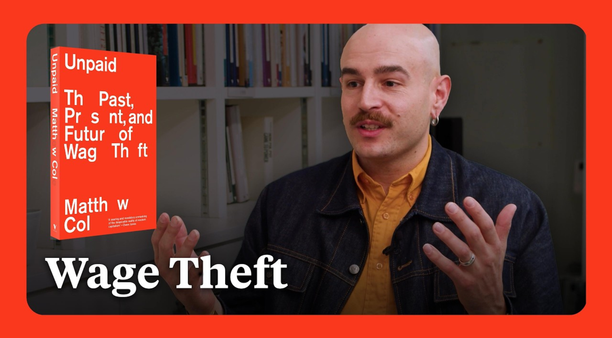
Yesterday, Ross Perlin, author of Intern Nation: How To Earn Nothing and Learn Little in the Brave New Economy, made an appearance on MSNBC's "The Dylan Ratigan Show," where he discussed the negative impact of internships on the economy and the increasingly exploitative nature of unpaid work:
Visit msnbc.com for breaking news, world news, and news about the economy
Recently, a number of news outlets have reported on the increasing numbers of college grads taking unpaid internships--and the steadily growing backlash to this condition, citing Ross Perlin’s groundbreaking study, Intern Nation. Time Magazine predicts the end of the unpaid internship, with Perlin noting,“I think we may be at the very early stages of a significant backlash against an internship phenomenon that has gone off the rails.”
However, The New York Times reports that the demand for unpaid internships remains high despite. Speaking to journalist Steven Greenhouse, Perlin reflected,
The people in charge in many industries were once interns and they’ve come of age, and to them unpaid internships are completely normal and they think of having interns in every way, shape and form.
Perlin also appeared in a video interview for The Nation to speak about precarious labor as a whole, pointing out the ways in which internships fit into a larger picture of a new precarious class. He additionally spoke to The Bat Segundo Show about the difficulties of gauging public opinion on internships, stating:
I think it’s hard to know what the degree of public support for interns is. In the UK, the public has been polled on the issue. And there’s a very strong feeling that interns should be paid. And a very strong majority feels that what goes on now is wrong. In the U.S., it’s hard to know. But I suspect you would still see most people thinking interns should be paid. But there are complex feelings. And I think that part of it is because there is, as you say, a strange dichotomy. Interns are both privileged and exploited at the same time.
The updated paperback edition of Intern Nation is now available.
Following up their article on The Ethics of Unpaid Internships, which traverses the legal and ethical swamp of the US intern economy, U.S. News has interviewed Intern Nation author Ross Perlin to get the full scoop on growing trends in internship culture. Ross describes the two main arguments in his book as follows:
One is that the internship system, if you can call it that, is chaotic and sprawling, and in many ways has gone off the rails; it's not working as it should ... Companies are not using internships in the way they used to in many cases, as a recruiting pipeline, as a way to bring talent into the firm. They're using them as a cheap labor force that they're cycling through without any prospect of bringing [interns] on as regular workers.
His second argument is that internships possess a highly unequal class character—perhaps not a phrase (or political argument) that the readers of the U.S. News business page are all too comfortable with.
There is a social justice issue here. If you have the gateway into the workforce being something where you have to come from a well-off-enough background ... people who are from [big cities] where internships are concentrated and have a place to live or are from families that have the money to enable somebody to work unpaid for a summer or six months or even a year, those people are at a serious advantage.
Are interns destroying the value we place in work? Can we increase social mobility by reforming work experience? Or should they just be abolished?
Ross Perlin, author of Intern Nation, joins Aditya Chakrabortty to discuss the impact of paid and unpaid internships on our economy. Also in the studio are Heather Stewart, the Observer's economics editor, and - a week into his own work experience at the Guardian - Christian Eriksson.
Aditya Chakrabortty: Who is excluded in intern culture?
Ross Perlin: First off, those who don't attend university to begin with are almost completely excluded, or those who don't go to better known universities, with the resources, with the kind of name brand that allows people to go out and land an internship. So first off, you have all those people who are effectively consigned then to the blue collar world as internships become the gateway to the white collar workforce. And with the white collar work force being the sort of sight of high paying influential jobs in a service based economy, this is a serious problem.
But then even at another level, with in those who do attend university, there is a real division between people... who can do this for a brief period of time, but then as soon as their student loans run out, or they're out of school, they have to move on and find paying work. So, as you see the rise of postgraduate internships, as you see people doing this during gap years, or while they kind of tread water while they're waiting for a regular job to materialize, those people are much more likely to come from well-heeled backgrounds. Or to be making a significant sacrifice working on the side, bartending evenings, doubling down on student loans, going deeper into debt, which will cause problems later on. So you see a significant number of people excluded. In the US I can say, you are really talking about 70-80 % of young people who really can not do any kind of work experience.
Andy Beckett reviews Intern Nation by Ross Perlin for the Guardian, describing the book as "a portrait of how white-collar work is changing ... thought-provoking and at times jaw-dropping – almost a companion volume to Naomi Klein's celebrated 2000 exposé of modern sweatshops, No Logo."
Citing the Mail on Sunday story that reported how the Conservatives' auctioned off a selection of prestigious internships for between £2,000 and £4,000 pounds as the beginning of media interest in the divisive world of internships, Beckett suggests that the internship boom has since become a significant British political issue:
[S]trikingly, almost everyone involved in the controversy seems to agree on one thing: that a few days' vaguely defined work as an intern is now a crucial early building block for a desirable, decades-long white-collar career. As Ross Perlin puts it in this timely and clear-sighted book, the first on the internship boom, "In much of the developed world, the subtle, relentless pressure to do an internship is now simply part of being young ..."