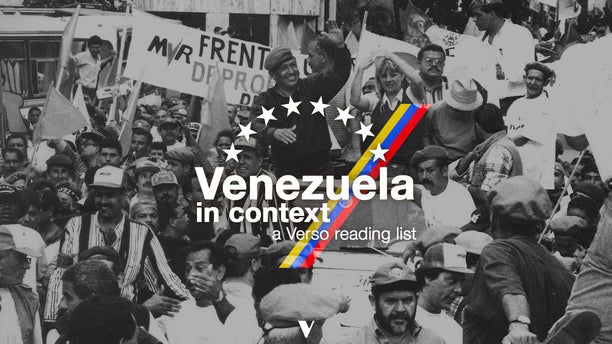
Hugo Chávez has returned to Venezuela in time for the 200th anniversary of Venezuelan independence today. He had been undergoing treatment for cancer in Cuba.
Also, last week it was revealed through Wikileaks that the Catholic church was involved in the 2002 US-backed attempt to topple Chávez by military coup.
Among the latest revelations to emerge from WikiLeaks is that, in 2002, as plotters in Venezuela's capital Caracas were liaising with the US authorities about the conspiracy to topple President Hugo Chávez, the leaders of the Catholic church in that country were defying the instruction of Pope John Paul II to desist from having anything to do with the coup d'état. Instead they threw their lot in with Pedro Carmona, the extremist rightwing businessman, who took office for less than 48 hours during a brief military coup in April 2002.
Please note that the deadline has now been extended to 30 July.
Verso and The Church of London are pleased to announce a new short film competition to mark the publication of Slavoj Žižek's Living in the End Times. The competition is launched in the May/June issue of Little White Lies.
Shooting Zizek creative brief:
The end is nigh, film it fast ...
Global capitalism is fast approaching its end times, says "the Elvis of cultural theory" Slavoj Žižek in his new book, Living In The End Times.
We've been amazed at the response on Twitter to the #philosophyfilms hashtag over the last few days.
We gave prizes to our favourite three, which were Husserl and Flow (@_brennavan), Lukács Me If You Lacan (@Ulillillysses) & Brokeback Montaigne, by @julesevans77 who also came out with Voyage to De Botton of the Sea and Zeno Evil Hear No Evil .
There were so many it was impossible to look through them all, so we missed some corkers. Here are the best of the rest:
Badiou Tenant (@stevenpoole)
How Deleuze Friends and Alienate People (@terryacraven)
Fichte of Fury (@montserratian)
Bend it Like Bentham (@davidcmoulton)
Look Who's Dworkin (@donchip1)
I Hardt Huckabees (@shiftzine)
Fast Times at Ridgemont Heidegger (@endamacnally)
To mark the new exhibition, Vorticists: Manifesto for a Modern World, which opens at the Tate Britain today, Verso are giving away Fredric Jameson's classic book, Fables of Agression: Wyndham Lewis, the Modernist as Fascist, along with two of his other books.
While Fables of Agression primarily focuses on Wyndham Lewis' novels, Lewis was also the founder of the short-lived avant-garde Vorticist art and poetry movement. Among its other key members were the artists Jacob Epstein and Henri Gaudier-Brzeska, and it was also linked with modernist poets Ezra Pound, who gave the movement its name, and T. S Eliot).
The Tate exhibition focuses on the art of the Vorticist movement and the paintings of Lewis, Epstein and Gaudier-Brzeska, showcased in the only two Vorticist exhibitions ever to have taken place. It also highlights the often overlooked female Vorticists, who included Helen Saunders and Dorothy Shakespear. From the exhibition blurb:
Vorticism was a radical art movement that shone briefly but brightly in the years before and during World War I. This exhibition celebrates the full electrifying force and vitality of this short-lived but pivotal modernist movement that was based in London but international in make-up and ambition ...
This exhibition aims to shine a new light on this revolutionary group of artists, presenting the style, radical aesthetics and thoughts of one of the most truly avant-garde art movements in British history.
John Harris reports for the Guardian on the the dangers of 'zero tolerance' policies and excessive surveillance in schools, citing Annette Fuentes' Lockdown High as a cautionary tale for UK education. In particular, he warns against assuming this is a predominantly American story, citing examples which show how far down the road to schools-as-prisons the UK has already gone, and how those making education policy are, in at least one case, entwined with those who stand to profit :
Lockdown High tells a story that decisively began with the Columbine shootings of 1999, and from across the US, the text cites cases that are mind-boggling: a high-flying student from Arizona strip-searched because ibuprofen was not allowed under her school rules; the school in Texas where teachers can carry concealed handguns; and, most amazingly of all, the Philadelphia school that gave its pupils laptops equipped with a secret feature allowing them to be spied on outside classroom hours.
Just about all the schools Fuentes writes about are united by a belief in that most pernicious of principles, "zero tolerance". Their scanners, cameras and computer applications are supplied by a US security industry that seems to grow bigger and more insatiable every year ...
It would be comforting to think of all this as a peculiarly American phenomenon. But in the UK, we seem almost as keen on turning schools into authoritarian fortresses. Scores of schools have on-site "campus police officers." One in seven schools has insisted on students being fingerprinted so they can use biometric systems for the delivery of lunches and in school libraries. Security systems based on face recognition have already been piloted in 10 schools, and on-site police officers are now a common feature of the education system. Most ubiquitous of all are CCTV cameras: in keeping with our national love affair with video surveillance, 85% of secondary schools are reckoned to use it, even in changing rooms and toilets.