Afterword to "Theory of Immediate World Revolution"
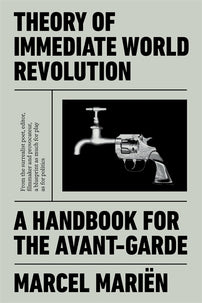
The afterword of the German translation of Belgian Surrealist Marcel Mariën's Theory of Immediate World Revolution, out in English for the first time this September. Preorder now for 30% off until Tuesday, June 16th.

Marcel Mariën, Le juste (La conscience tranquille) (1991), Silver print.
“[Theory of Immediate World Revolution] drew from something very serious: it took the nuclear specter at face value. What can we do when we’re suffocated by the throat? The answer remains clear and unchanged: anything. Today’s reader may consider this reflex of yesteryear as human against human threats have multiplied and diversified. And if they cannot, so be it. After all, this is about all that we can do given that we all, since the day we are born, carry within us the genes of the end of the world.”
In the following 1989 reflection, Marcel Mariën discusses personal influences on his 1958 Theory of Immediate World Revolution from longtime friends including Michèle Bernstein, Paul Nougé, and René Magritte. He broadly traces how his motivations and political tendencies changed over time and context, particularly when confronted with multiple faces of the Soviet Union. This short reflection was printed by Mariën in French in a rare pamphlet disseminated by his publishing company, Les Lèvres Nues (1990), after appearing in German as a Postface to the German edition of Theory of Immediate World Revolution (Weltrevolution in 365 Tagen, Tiamat, 1989.)
Marcel Mariën, “Attack on the Grey Heavens,” Brussels: Les Lèvres Nues, 1990.
[book-strip index="1"]
Afterword to the German translation of Theory of the Immediate World Revolution, published by Les Lèvres Nues in 1958.
“These Parisians storm heaven as though they were Prusso-German Holy Roman slaves of heaven.” Karl Marx, Letter to Kugelmann, April 12, 1871.
In the period surrounding World War II, Marxist consciousness was sure put to the test, shuffling from right to left until no one, including the left, knew where right or left fell. Paul Nougé,[1] a founding member of the Belgian Section of the Third International Communist Party in 1919, felt, like many others, punched in the stomach by the German-Soviet Pact. He definitely would have joined André Breton to support Trotsky if the war had not drawn a strict border between Europe and the rest of the world. It was all fun and games for Breton to berate Stalin from New York and for Mesens to berate him from London. Meanwhile, we had been living with immense hope for the Soviet army as we saw their long struggles. Suddenly, we saw the Soviets reborn atop a mountain of corpses when “from Stalingrad, […] there came a deep, vast, triumphant roar.”[2]
People felt drunk with liberation. Communist party membership surged so dramatically that they had to start recruiting in cafés and on street corners. Membership lines queued outside grocery stores again, a tradition that had not been entirely lost. But the Communist Party could not handle such success. Soon enough, this membership influx was met with discouragement and fatigue. It was as though communist parties were just naturally meant to shrink, like the famous bar of soap that Swift compared to human life.[3]
Magritte, celebrating his sign-up and admittance with pomp and circumstance,[4] officially joined the Belgian Communist Party, and right away Zhdanov’s bull head charged at us with all his cultural taboos. It took me a long time to understand that Communist parties existed solely to support the foreign policy of the USSR.
I remember a party one night in the 1950s at the Communist Party headquarters in Brussels that was attended by about twenty painters and a few political leaders. The party celebrated a juried exhibition that decided which paintings would be displayed under Picasso’s dove that soared above Cold War skies. The mishmash presented miners’ heads, damp dockworkers, working-class interiors, and May Day parades. Among them, only one canvas forcefully emerged: Magritte’s depiction of a rifle against the wall of a room. From barrel to stock, thick blood streamed down to a red puddle on the floorboards.
After quick glances at each piece, the crowd devoted the rest of the party to bitterly criticizing Magritte’s painting over the course of at least two hours of empty discussion. Magritte, Nougé (who also attended), and I noticed how The Survivor[5] (Le Survivant, the title of the painting) was the only one to effectively capture attention and elicit passionate commentary [Figure 1].

[Figure 1]: René Magritte, The Survivor (Le survivant), Oil on canvas (Brussels, 1950). Wikiart, public domain.
It was sure something to people rambling, concerning themselves with “the people’s art.” Invented by Count Tolstoy, supported by Plekhanov, sanctified by Lenin, and imposed by Stalin before echoing through caves of Yan’an, we later would all clearly see how these simplistic theories were meant to justify an all-powerful Saint-Sulpician Superman, Stalin or Mao, in the name of the people’s needs.
We suspected this but weren’t sure at that point. Magritte […] tried to uphold common sense, while I leaned to Trotsky, unlike Nougé, who didn’t deify but nevertheless defended Stalin as the best representative of concrete revolutionary achievement, superseding even the most seductive theories.
Then we suddenly remembered a popular book that gave us the intellectual justifications that we were looking for, easing our doubts. This admirable but misleading book was Arthur Koestler’s Darkness at Noon (Le Zéro et l’infini),[6] which had an unusual success story. Published in London in 1939, its distribution was brutally met by the war. The 1945 French translation received the most unexpected support: the Soviet embassy in Paris. Anxiously trying to destroy the book’s reach, the embassy tried to remove it from bookstores by secretly buying large quantities. But the publisher printed more editions, and word of mouth got around. Nougé, Magritte, Scutenaire, and I devoured the poisonous book, which seemed to offer a flawless explanation of the century’s greatest mystery: the Moscow Trials. It took an entirely different angle (it was not at all Marxist) for us to see the massacre of the old guard. It would take life experience, sixteen months residing and working in Maoist China, for me to fully wake up. (It makes me think of a very good economist Bettelheim, who devoted his life to studying and defending the Soviet economy before discovering with horror that he had not been able to see how it is merely a variant of the capitalist economy.)[7]
In 1957, I defiantly decided to write a pamphlet titled When the Steel Broke (Quand l’acier fut rompu) after I heard a repentant former Stalinist on the radio. I remember how he raged with just a bit too much cynicism about what he once adored. I advocated for the posthumous Stalin as though he were a fallen angel. My argument could be summed up in a single sentence, the last sentence in the book: “I don’t remember the name of the woman who was so astonished to read in the paper that Dr. Petiot was such a great criminal. He was the same doctor who healed her.”[8]
I stuck to this role of faithful non-believer until a friend — I think it was Michèle Bernstein — asked me how a proletarian revolution could occur if every attempt were bound to fail. At that time, I happened to be a temp typist for an advertising agency, so, in spite of myself, I got to know some modern market research methods for evaluating and manipulating the preferences and opinions of the average person on the street. I was particularly struck by the importance of social circles because class differences become less pronounced in realms of common interests: sports, stamp collecting, chess, art, blindness. This is the origin of the idea that, if two parties oppose each other just for show, it is possible to rally everyone.
I took this initial concept then grafted a very Cold War sentiment onto it: the possibility, as the newspapers were constantly hammering into us, of nuclear eradication of all life on the planet. While this issue persists today, it had different emotional resonance back then because the idea had not yet become familiar, even common. That’s why my program had to be so “immediate,” carried out, at max, within a year.
When my book was published in 1958, I thought it was appropriate to dedicate it to the so-called “literary fool” (fou littéraire) followed by a question mark. It was partly meant to be funny, I was also thinking of a serious quote by Paul Valéry, which remains relevant today: “Intellectuals must stir up everything using signs, names, or symbols, without the counterweight of real actions.”[9]
Thirty years have passed. I have no reason to smile back at my theory; it even feels foreign to me now. [Theory of Immediate World Revolution] drew on something very serious: it took the nuclear specter at face value. What can we do when we’re suffocated by the throat? The answer remains clear and unchanged: anything. Today’s reader may consider this reflex of yesteryear as human against human threats have multiplied and diversified. And if they cannot, so be it.
After all, this is about all that we can do given that we all, since the day we are born, carry within us the genes of the end of the world.
February 1989.
[book-strip index="1"]
[1] Paul Nougé, not only the leading thinker, along with Magritte, of Belgian Surrealism, but also one of the leading thinkers of his time according to Francis Ponge. André Breton quotes him toward the end of the “Second Manifesto of Surrealism” (1930): “Nougé recently wrote, ‘I think it would be great if those among us who have started making names for themselves start erasing those names.” Without knowing exactly to whom he was referring, I agree that it is not too much to ask for people to stop performatively parading themselves around as though they’re constantly on stage. Really, we should be shunning public approval. Nougé (1895-1967) avoided [the public] so well that he did not publish his theoretical writings until 1956 in Histoire de ne pas rire and in 1966 his poetic oeuvre, L’Expérience continue, which were later reprinted by L’Age d’Homme in Lausanne.
[2] Editor’s footnote: Vasily Grossman, Life and Fate, trans. Robert Chandler, New York Review of Books, 2006.
[3] Editor’s footnote: Mariën is most likely referring to Jonathan Swift, “Meditation upon a Broomstick,” Miscellanies in Prose and Verse (London: John Morpew, 1711.)
[4] Le Drapeau Rouge, Brussels, September 9, 1945. Editor’s Note: Christian Dotremont, “Le peintre Magritte adhere au Parti Communiste,” Le Drapeau Rouge (Brussels: Sept 8-9, 1945): 2.
[5] Editor’s Footnote: René Magritte, The Survivor (Le survivant), Oil on canvas (Brussels, 1950). Wikiart, public domain.
[6] Editor’s Footnote: Arthur Koestler, Darkness at Noon, trans. Daphne Hardy (New York: Scribner, 1940.)
[7] Note that this is the economist and not the psychologist, which the German edition erroneously indicated.
[8] Doctor Petiot was arrested and guillotined in 1944 for sixty-three accused and twenty-seven convicted assassinations. It is said that when he was being executed, he had to comfort the Attorney General because it was too painful to watch. (Réouven, Dictionnaire des Assassins, 1974). Editor’s note: René Réouvan, Dictionnaire des Assassins, Denoël, 1974: 295-298.
[9] Editor’s footnote: Paul Valéry, Tel Quel (Paris: Gallimard, 1960).