Limits and Beyond
In our final instalment of Harvey at 90, Eric Sheppard takes us through Harvey's seminal Limits to Capital (1982)

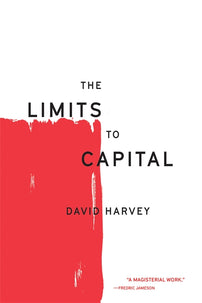
Limits to Capital is David’s foundational text, in three senses: foundational to his own thinking since 1982, to the flourishing body of scholarship on geographical political economy, and to his current reputation as one of the world’s foremost Marxist geographers/economists. It appeared almost a decade after Social Justice in the City, time spent ensconced close to the heartbeat of global capitalism, teaching at Johns Hopkins where he first read Capital with students and colleagues, and spending time in Paris—where he has recalled failing to connect with French Marxists and, as a geographer, turning to study the city itself.
By now quite dissatisfied with arguments made in Social Justice, in Limits David sets out to teach himself and other geographers (much like with Explanation) Marx’ theorization of capitalism. As noted in the introduction (p. xvi), he followed Marx’ method; “At each step […] we encounter antagonisms that build into intriguing configurations of internal and external contradiction. The resolution of each merely provokes the formation of new contradictions or their translation on to some fresh terrain.” He builds book’s argument around three steps. The first rehearses the main building blocks of Capital, culminating in what he calls a ‘first cut’ theory of capitalist crisis—very much as developed by Marx. The second takes up issues of fixed capital, money, credit and finance capital, culminating in what David dubbed a ‘second cut’ theory of crisis. This examines monetary aspects of crisis, focusing on the contradictory capacity of credit to overcome inter-temporal disequilibria in the demand for and supply of the money needed to complete capitalist transactions. Third, he takes up questions of space: land rent, transportation, the spatial mobility of capital and labor, built environments and uneven geographical development. Drawing these together his ‘third cut’ into capitalist crisis theorizes how, as capital agglomerates in places with high potential profit rates—taking advantage of agglomeration economies—eventually advantage transforms into disadvantage as ageing infrastructure and fixed capital, labor activism, enhanced local competition, increasing rents and shifting patterns of geographical locational advantage undermine local profitability. Capital responds to such localized crisis by switching to new locations whose relative profitability has become greater—only for the cycle to repeat. Uneven geographical development is thus an inherent feature of capitalism, not a bug, driving shifting patterns of socio-spatial inequality. These second and third cuts supplement Marx’ theorization by highlighting other vectors of crisis, nevertheless concluding with Marx that neither finance nor uneven geographical development enable capitalism to escape what he calls, in Seventeen Contradictions and the End of Capitalism (2014), its foundational crises—capital’s limits.
While Limits is a purely theoretical monograph David saw it as a necessary diversion from his real interest in making sense of events in Paris and Baltimore (the former appearing in 2003 as Paris, Capital of Modernity). Yet, with the exception of Paris, this diversion became a leitmotif as subsequent books remained in the largely conceptual domain of developing geographically sensitized Marxist critiques of general developments in capitalism and the possibility of socialist alternatives. Limits was the starting point for his subsequent intellectual development, even as he went on to interrogate such seemingly different questions as environmental change, postmodernism, utopias, urban politics, the body and possible worlds.
[book-strip index="1"]
The originality and resonance of Limits relative to Marxist scholarship at the time lies in this last, ‘spatial’ section. In the spirit of dialectical reflexive extension derived from Marx, David spatializes Marx’ theory to develop a series of concepts—class monopoly rent, circuits of capital, the spatial fix, concentration and dispersal and the like—that have become legion in geographical political economy. Importantly, he did not simply add space to Marx’s occasional references to town and country, etc. He went further to interrogate how a geographical perspective requires modifications to Marx’ analysis. This helped instantiate what is now a long-standing tradition of geographical theorizing extending across radical/critical geography, that David himself had previously encountered in mainstream theories of spatial competition. Spatialities matter because incorporating geographical thinking into social theory can transform key theoretical propositions developed in its absence. This was controversial at the time; for example, I could never convince Marxist logician Erik Olin Wright that space (like time) has theoretical import—that spatialities are not only produced by social processes but in turn shape those processes—Ed Soja’s socio-spatial dialectic.
Limit’s appearance in 1982 was a revelation for me and other ‘first generation’ Marxian geographical political economists. By then we had each experienced our own self-education through Capital and related reading groups, so it was inspirational for someone to pull this together through a geographical lens. Within a decade Limits had been followed by 5 or 6 monographs taking up its geographical implications and the scholarly community exploded from there. Over time, more squarely Marxist scholarship found itself critiqued for failing to address questions of feminism, postmodernism, poststructuralism, the environment, the body and postcolonialism. David responded to these critiques in subsequent books, working to modulate his thinking in order to take up these critiques as he saw them. Yet the critics were often unconvinced and core Marxian themes, seen as redolent of white masculinist thinking, became marginalized as radical geography diversified into critical geography. Nevertheless, Limits remained key to enabling the rise to dominance of radical/critical geographers within Anglophone human geography, and to the take-up of spatial thinking in such cognate fields as cultural anthropology, feminism, heterodox economics and political sociology.
If the foundational impact of Limits on geographical political economy and geography more broadly was established by the 1990s, its transformational impact on David’s scholarly reputation only occurred in 1999, once folks at Verso ‘discovered’ and reprinted Limits (also in 2006 and 2018). No longer ‘merely’ a geographer publishing in Basil Blackwell with his favorite editor, John Davey, the Verso imprimatur and publicity machine helped catapult him into the Marxian stratosphere (citations of Limits alone quadrupled within a decade). I certainly don’t mean to imply that Verso made you, David; simply that, as a geographer, you needed a wormhole through which to escape our parochial marginalization by the many who don’t appreciate the richness of thinking geographically.
[book-strip index="2"]
Writing a new introduction to Limits in 2006, David argued that it had become even more relevant for the world of the early 2000s: One of free market capitalism, finance-led globalization, the restoration of class power and an increasingly cannibalistic capitalism triggering its own resistances—ranging from a grassroots worldwide justice movement to globalizing China. Noting that there is much still to be done, in his view Limits remained “the only text I know that seeks to integrate the financial (temporal) and geographical (global and spatial) aspects to accumulation” deploying a relational/dialectical theorization of spacetime. Subsequent developments—the 2008 global economic meltdown triggered just down the road from him in Wall Street, the 2011 Occupy and Arab Spring movements, global heating and the unprecedented concentration of wealth in the hands of the 0.01%—could be seen as doubling down on his claim.
Much has changed since 2016, however. Those largely fruitlessly protesting neoliberal globalization unsuccessfully on the left and from the global south were replaced by conservative critiques by those who—while still prosperous relative to the global south—saw themselves as northern victims of globalization. We now find ourselves moving beyond the conjuncture deregulated global capitalism, with an emergent conjuncture dominated by authoritarian, masculine ethnonationalist capitalism—neoliberalism behind borders—now a distinct possibility. Global heating is accelerating, with the wealthy world unable and unwilling to do much about it—sustainability giving way to resilience. Northern capitalism is plagued by rentiership with financialization increasingly unhinged. While ‘free trade’ was always a chimera, the free trade doctrine has given way to tariff wars—with the WTO marginalized and the rest of the world cobbling together a less US-centric system. Like Dracula, xenophobia, masculinism, white supremacy and homophobia are escaping the grave that northern liberalism had assigned them to. Geopolitical alliances are being restructured as Trump et al. set about fracturing US hegemony. China has launched its own globalization and development project, ordaining a state-led green transition that northern capitalism has studiously avoided. Capitalist digitization has turned our data into a rent-seeking asset, has unleashed an almost certainly unsustainable investment bubble around AI (cf. the dot.com crisis forty years ago), and is plundering the environment for its data centers.
Some of this lies within the domain sketched out in Limits, some has received subsequent attention from David, and his The Story of Capital (2026: his 21st book and 5th with Verso) takes up much of the remainder. The Story of Capital returns to core themes developed in Limits, now made accessible to a broader audience. He includes topics left on Limits’ cutting-room floor or given short shrift therein—nature, the state, geopolitics and variegated capitalism—all suffused with his geographical sensibility. Deploying an intellect as restless as capital itself, David has composed variations building on Limits that reflect his own intellectual development and engage with capitalism’s geographical evolution. Limits lives!
So, thank you David! As you celebrate your ninetieth, no doubt with many gifts, we celebrate Limits as a gift to us all that keeps on giving.