"Through Japanese Eyes" | An excerpt from Wilfred Burchett's Shadows of Hiroshima
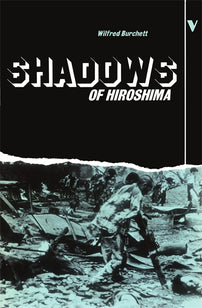
August 6 is the anniversary of America's bombing of Hiroshima. Read an excerpt from Shadows of Hiroshima by Wilfred Burchett, the first western reporter to enter Hiroshima after the nuclear bomb was dropped.

The text below is an excerpt from Shadows of Hiroshima by Wilfred Burchett, available again in print for the first time in years.
[book-strip index="1"]
Dismayed by the American authorities' lack of interest in the condition of the A-bomb victims, and by their refusal to share knowledge on the subject with Japanese medical scientists, the Science and Education Bureau of Japan's Ministry of Education set up, together with the country's Scientific Research Council, a 'Special Committee for the Investigation of A-Bomb Damage'. On 21 September, five days after the Committee was established, an advance crew from the Nippon Eiga-sha Film Corporation, commissioned to document the Committee's work, arrived in Hiroshima. Less than a month later, by which time one of the Eiga-sha cameramen had been arrested by Occupation authorities in Nagasaki, the photographing or filming of scenes of A-bomb havoc were banned. On 30 November, the Special Committee presented its first report at Tokyo's Imperial University. On that same day a directive was issued from MacArthur's headquarters requiring any organization to have special permission to conduct research on any matters concerning the effects of the atomic bombing of Hiroshima or Nagasaki.
At the beginning, all hopes of the Japanese medical and scientific community were based on American aid and expertise. After all, the Americans had built the Bomb, they reasoned, so they must know what the medical effects would be and have developed therapies and medication to deal with the injured. But the days and weeks went by and there were no signs of any help, sympathy or even interest in the fate of the survivors. Dr Michihiko Hachiya, director of the Communications Hospital, kept a diary from 6 August to 30 September. There is an entry on 20 September, which reflected these misplaced hopes. It was shown to me, during a visit to Hiroshima in 1981, by Dr Shigeto, director of the Red Cross and Atom Bomb Victims' Hospital.
After lunch I was dozing on a bed near the window when Mr Sera hastened in, out of breath, and whispered excitedly: 'Sensei, there's an American officer outside.'
Startled by his words, I was speechless for a moment, and felt fear and anger surge through me. Feelings of hostility got the upper hand and before I had collected my wits I exclaimed in a curt voice;
'Sera-san, ignore him!'
'Sensei, don't say such things!', he rebuked me and went on excitedly. 'He's at the entrance now. Please see him!'
Gradually, my feelings of hostility gave way to fear and I knew I had no alternative but to see the officer. I was dressed in dirty pants and shirt and, with my mind in the state it was, hardly felt up to confronting the foreigner.
The next moment, I heard steps on the stairs and in walked a dignified, stately officer accompanied by a dark-complexioned guard, wearing a pistol at his side, who assumed the role of interpreter. I informed the pair that I was the director of the Hiroshima Communications Hospital and, after acknowledging each with my eyes, I offered to show them around the wards.
The officer was more interested in the typhoon than the A-bomb casualties. He knew what had happened at Miyajima during the storm and kept asking how we had fared. The interpreter, I discovered, knew little Japanese, so what we had to communicate to each other was poorly relayed. After we had looked around and were making our way to the entrance, we ran into my wife. The officer asked if she had been injured and I told him she was anaemic and had received some wounds. I rolled up her sleeves and showed some scars. He nodded slightly and left.
After he had gone my heart pounded violently and my legs began to ache. I had forgotten to go down to the entrance with him, I was so disturbed.
Ten days later, two more groups of Americans visited the hospital. The first group 'made a minute examination of everything I called to their attention.' The second group in Dr Hachiya's account:
... had a Japanese-American interpreter whose family had come from Tanna. With this group I stayed in the improvised drawingroom and talked through the interpreter. One of the men stood at the window, looking over the ruins and, at length, said through the interpreter: 'There must be dead still in the ruins, and I have the feeling that if the ruins aren't removed and the bodies disposed of, ill-will between both countries will be prolonged. What is your opinion?'
'I agree with you,' I answered. 'I hear that you are using a useful machine in Kure to clear up the ruins, a •bulldozer" I think it is called. Couldn't you have one sent to help us clear up the city? Otherwise I am sure that those who were injured and those who lost relatives and friends will be continually reminded of the day they were bombed and hate you when you come back to Hiroshima.'
'It's out of the question,' the officer replied. 'America can't afford to send such equipment in here now. What are your thoughts about the bombing?'
'I am a Buddhist,' I replied, 'and since childhood have been taught to be resigned in the face of adversity. I have lost my home and my wealth, and I was wounded, but disregarding this, I consider it fortunate my wife and I are alive. I am grateful for this even though someone was to die in every home in my neighbourhood.'
'I can't share your feelings,' the officer replied sternly. 'If I were you, I'd sue the country.'
The officer stood a while longer and gazed out the window. Finally, he and his party departed. After he had gone I told my friends what he said. 'Sue the country! Sue the country!' I repeated over and over to myself. But no matter how many times I repeated it, and however hard I thought, the statement was altogether incomprehensible.
It was 'incomprehensible' unless one accepted the official American thesis that it was the Japanese leadership, the Emperor in particular, that was responsible for the A-bombing of Hiroshima–not the United States. Dr Hichaya's diary ends at that point. By 30 September, twenty-seven days after the surrender had been signed, no American doctors had visited the Communications Hospital, or if there were any among the two groups mentioned, none had offered any advice as to how the survivors should be treated. In a postscript to his diary, Dr Hichaya notes that 'towards the middle of October, I was visited by Professor Sasa of Tokyo University, who brought an investigating committee of Americans. This group remained in Hiroshima for about a month, studying radiation sickness.' But there is no mention of any treatment or advice on treatment for the hospital inmates.
There is a fascinating earlier entry in Dr Hichaya's diary (15 August) which reflects the prestige and authority of the Emperor, unimaginable unless one has been in Japan. It is a phenomenon that everyone, left, right or centre in the political spectrum, has to take into account and which bears directly on the Japanese reactions to Hiroshima and Nagasaki.
Word came to assemble in the office of the Communications Bureau. A radio had been set up and when I arrived the room was already crowded . ... In a few minutes, the radio began to hum and crackle with noisy static. One could hear an indistinct voice which only now and then came through clearly. I caught only one phrase which sounded something like, 'Bear the unbearable.' The static ceased and the broadcast was at an end.
Chief Okamoto, who had been standing by the radio, turned to us and said: 'The broadcast was in the Emperor's own voice, and he has just said that we've lost the war. Until further notice, I want you to go about your duties.'
I had been prepared for the broadcast to tell us to dig in and fight to the end, but this unexpected message left me stunned. It had been the Emperor's voice and he had read the Imperial Proclamation of Surrender. My psychic apparatus stopped working, and my tear glands stopped too. like others in the room, I had come to attention at the mention of the Emperor's voice, and for a while we all remained silent and at attention. Darkness clouded my eyes, my teeth chattered, and I felt cold sweat running down my back.
To myself I began denouncing the army: 'What do you fellows think about the Emperor? You started the war at your pleasure. When the outlook was good, you behaved with importance, but when you began to lose, you tried to conceal your losses, and when you could move no more, you turned to the Emperor! Can you people call yourself soldiers? You have no choice but to commit harakiri and die!'
As if echoing my thoughts, someone shouted: 'General Tojo you great, thick-headed fool, cut your stomach and die!’
Tojo intended to do just that, but lost his nerve at the last moment and tried to commit suicide with a pistol. I was in his room with other journalists seconds after he tried to put a bullet in his heart. We had accompanied us military police who were to arrest him at his Tokyo home, but were assured by the servant who answered the door bell that he had 'gone for a walk' and would soon be back. While the MPS were discussing what to do next, a shot rang out. When we rushed in, Tojo had collapsed into an arm-chair, feathers from a cushion behind his back floating down. On a table in front of him were laid out his sabre and samurai dagger, customarily used for a ritual harakiri. American medical personnel hastened to give a plasma transfusion; agency journalists fought each other to get to the telephone. Doctors succeeded in saving his life, temporarily. He lived to be tried as a war criminal and was hanged in December 1948.
I had sensed the contempt of troops towards the officer caste on my way to Hiroshima. But the feelings of civilians towards the military as a whole were expressed far more strongly during the return trip. In fact this was quite dramatic. Civilians who tried to board the train between Tokyo and Kyoto were roughly pushed back by the troops. On the return journey it was the civilians who just as roughly pushed back the troops, especially officers, who tried to board the train. This made a deep impression on me at the time, and on numerous subsequent visits I found that the strong anti-militarist feelings of the Japanese people had not subsided and there was widespread contempt for anyone in military uniform. But the Emperor remained sacrosanct.
Another extreme example of the heights or depths-according to how one views such matters-of Emperor worship is contained in Dr Hichaya's diary entry of 13 September, in which he relates how the Emperor's portrait was moved to a safe place while Hiroshima was an inferno of swirling flames, crammed with dead and dying-a city-sized crematorium. The occasion of the belated account was his meeting on that day a Mr Yasuda, 'who had the grave responsibility' for protecting the picture of the Emperor which hung in the city hall.
He was on a streetcar which had just reached Hakushima when the bomb exploded. Making his way through the darkened streets and around fallen houses, he managed to reach the Bureau ahead of the fires. His first act on arriving was to run to the fourth floor where the Emperor's picture hung and pry open an iron door behind which it was kept. With the assistance of Awaya, Oishi and Kagehira, he carried it to the chiefs office and discussed with Mr U shio what should be done with it. After much discussion it was decided the safest place would be the Hiroshima Castle, where less smoke appeared to be rising than elsewhere.
Thereupon the picture was placed on Mr Yasuda's back and with Mr Kagehira in the lead, Mr U shio guarding the rear and Mr Awaya and Mr Oishi covering the flank!f, they made their way to the inner garden of the Bureau and announced they were going to take the Emperor's picture to a safer place. Two or three times they repeated: 'The Emperor's picture will be transferred to the West Drill Field by the Olief of General Affairs!' Those among the staff and patients who heard this announcement bowed low and the procession went out through the back gate.
During its flight, the party encountered many dead and wounded, as well as soldiers near the barracks, the numbers increasing as they neared the dikes. Along the streetcar line circling the western border of the park they found so many dead and wounded they could hardly walk. At one point it became impossible, so great were the masses of people around them. The party shouted: 'The Emperor's picture! The Emperor's picture!' Those soldiers and citizens who could stood and saluted or bowed. Those who could not offered a prayer with hands clasped. Miraculously, the crowd opened and the picture was borne triumphantly to the river's edge!
'Oh, it was magnificent!', Mr Yasuda exclaimed. 'I gave the Emperor's picture to Chief Ushio and the chief got a boat someone unaccountably provided. An officer drew his sword and gave orders in a loud voice for the crossing and in response all the officers and soldiers lining the river bank stood at attention and saluted. Civilians stood in line and bowed. I can't explain how I felt, but I prayed that nothing would happen to the Emperor's picture ... Well, the river was calm and I can still picture Mr Ushio holding the Emperor's picture among the wounded soldiers.’
I might conclude Mr Yasuda's story by saying that shortly after Mr Ushio got the Emperor's picture safely across the river, the entire Futuba-no-Sato [city district] became a sea of fire. Whirlwinds and rain came. The river became turbulent and treacherous, its surface churned into great waves. Balls of fire flew over the river from the Futuba-no-Sato area and set fire to pine trees in Asano Sentei Park. As these great trees burned, swayed and toppled, the heat became unbearable. Houses were consumed and people crowding the river banks in an effort to escape the inferno, jumped in the river. Thousands were drowned. Mr Yasuda and Mr Oishi clung to a rock and escaped death.
So much for Dr Tachiya's dramatic and often chilling account of what he and other Hiroshima survivors lived through during and immediately after the A-bomb holocaust. It requires no comment. My own last report from Japan was on the attempted suicide of General Tojo, following which I made a leisurely journey to London, via the United States, for reassignment.
The text above is an excerpt from Shadows of Hiroshima by Wilfred Burchett, available again in print for the first time in years.
[book-strip index="3"]
[book-strip index="2"]