Total war as a neo-fascist mode of government
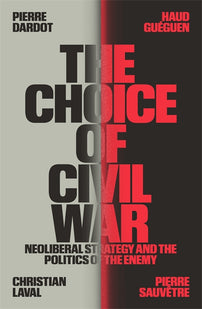
Christian Laval, co-author of The Choice of Civil War, on the escalation of the neoliberal order through the Trump administration's total war.

Trump is carrying out a protracted coup d'état right before our eyes, making his own contribution to the dismantling of liberal institutions and the rule of law. The US president is doing this through a continuous process, made up of abuses of power and transgressions of the legal order, all done in the name of an ‘emergency’, which itself corresponds to a civil-war logic. With ICE’s actions, the United States has, in fact, entered a new period of open civil war consciously waged by the federal government. We pointed toward these developments in our book, The Choice of Civil War. Indeed, the ingredients for this war had already arrived with the rise of neoliberalism. It is impossible to understand Trumpism if we detach it from the past, as some are tempted to do when they contrast the good-old multilateral neoliberalism, which supposedly respected the international order, with a bad new nationalist and imperialist capitalism that does not.
Today, neoliberalism is leading to a new kind of fascism, a neo-fascism, which stands in relation to historical fascism as neoliberalism did to classical liberalism: that is, as a particular species of a common genus. This neo-fascism in action offers grim confirmation of the arguments that we set out in our book. Neoliberalism, as a particular policy of capitalism since the end of the twentieth century, has been a political enterprise ready to use all means available to transform society in the interests of capital, by way of state coercion. Neo-fascism is, therefore, not just a type of fascism — a sad return to the darkest past — but also an exacerbated continuation of what neoliberalism intended to do in more roundabout ways, subjecting all society to the logic of private interests. Canadian Prime Minister Mark Carney may well make the finest of speeches in Davos, but he cannot make us forget that the cause he has defended and continues to defend is not as pure as he would have us believe.
In the neoliberal state’s efforts to establish a society structured by competitive relationships and dominated by market logic, it has constantly fought against the protective mechanisms enacted in an earlier historical phase, and more generally against everything related to civil and social equality. This reversal of protective and redistributive measures has across the last several decades given rise to terrible social ills and produced hostile reactions to capitalist globalisation. These reactions sometimes had to be forcibly resisted but also neutralised or even weaponised to build a new hegemonic bloc, through a war of values that divides the people and pits them against each other. This is the sociological and political driving force behind the metamorphosis of neoliberalism into neo-fascism, of which Trumpism is one of several historically specific forms.
Neo-fascism, even more than neoliberalism, openly embraces war, and total war against both internal and external enemies. It is even prepared to invent all kinds of enemies to impose its domination. This is what our book The Choice of Civil War called ‘enemisation’, i.e. the fabrication of enemies. This enemisation is necessary to mobilise all the resources available to the state and its capitalist and media allies to wage this war of terror. The renaming of the US Department of Defense as the ‘Department of War’ well encapsulates this logic.
A new era
This total war is not only American, it is global. Still, Trumpian neofascism serves as its bridgehead and model. The aim is clear and unapologetic: to destroy democratic institutions, even in the most minimal sense of the word ‘democracy’, in all countries, starting with the national sphere. But this total war knows no borders; its sphere of influence is global. There are no longer any allies, only enemies and vassals. Proof of this can be found in Trump's trade war against governments that are not aligned with his far-right policies, such as Brazil, Canada, France, etc. This is a considerable reversal in world history. The United States has claimed to embody resistance to fascism ever since World War II, whereas the Trump administration intends to spread fascism everywhere. The genocide waged by the Israeli government in Gaza is the most extreme form of global neo-fascism and, at the same time, the prism through which the reality of today’s world can be seen. That is, a world dominated by war, and a war that goes as far as the extermination of populations and the destruction of territories.
This new global regime of war obviously has many faces. It would be a mistake to separate them out from each other. The underlying logic, which overdetermines states’ internal political developments, is the clash between imperialist powers, notably between the United States and China, to redefine the world order in favour of one or the other superpower. But what is new — and indeed, stands in contrast with the Cold War — is that there is no opposition between political systems, as was the case between the capitalist West and the Soviet system. Rather, there is a rivalry between imperialisms that agree among themselves to liquidate the old forms of liberal democracy everywhere. The strangest and most disturbing aspect of this period is thus the anti-democratic Holy Alliance of rival powers, the United States, China and Russia, and all the secondary powers led by autocrats, against countries that still defend minimal forms of democracy and against populations that want more democracy.
[book-strip index="1"]
What characterises contemporary neo-fascism?
The characteristic of contemporary neo-fascism is war. The neo-fascist government does not aim to consolidate a consensus, a status quo or a hegemony; it does not seek merely to preserve an existing state. Rather, it seeks victory over an enemy that must be terrorised and crushed. To crush this enemy, the neo-fascist government must seize all the levers of power, transform institutions and put them into the service of a total mobilisation. Neo-fascism governs through war, and through total war. This is what most closely resembles historical fascism and justifies the use of this name.
To understand this mode of government by war, we must return to a key concept, that of the state of emergency. In the Roman Republic, the exception, or emergency, was the argument used in favour of dictatorship, which was presented as a necessary response to some exceptional situation that endangered the homeland. It is the moment when necessity becomes law (necessitas non legem habet). In a completely different context, the question of an ‘exceptional magistracy’ arose during the Weimar Republic. It revolved around the legality of the crisis-powers in the hands of the president (Article 48), which went beyond the powers of the German parliament. The jurist Carl Schmitt saw the state of emergency not only as an indispensable complement to the rule of law (its suspension over some limited period), but also as a permanent political reality based on the principle of sovereignty, presented as the legitimate exercise of unlimited and transcendent power. Schmitt sets out this well-known principle in the opening lines of his Political Theology: ‘He who decides on the exception is sovereign.’ In short, in a decisionist theory of this kind, the exception cannot be the subject of deliberation; it is decided by the sovereign.
This is exactly what Trump is claiming, subverting the US legal order by appropriating powers that belong to other institutions or spheres of activity that were supposed to be relatively autonomous (Congress, the media, science, culture, etc.). By citing the argument of emergency, Trump is establishing the absolutisation of state power, an exacerbation of the principle of sovereignty, and the establishment of arbitrary power by the leader in the absence of any countervailing power within society. The rule-of-law state [Rechtsstaat], whose power is limited and regulated by law, gives way to the absolute power of the person elected by the People (i.e. an electoral majority). How can this exception be justified? Precisely by war, and war that the sovereign himself declares against both internal and external enemies. This war is performative; its efficacy lies within itself. According to a supremely Schmittian sovereignist logic, the state declares a state of emergency that legitimises all violations of the legal order. The invention of the enemy in the discourse of war is thus an indispensable moment in the creation of a dictatorship. This enemisation soon extends to all opponents, who can be nothing but ‘traitors’, seeing as they are allied with the most dangerous enemies. It justifies the destruction of recalcitrant institutions, as they are quickly accused of protecting ‘terrorists’, ‘anarchists’, the ‘radical left’, etc.
The speeches that both Trump and his Minister of War, Pete Hegseth, gave before an audience of senior US military officers on Tuesday 30 September 2025 are a perfect demonstration of this mode of government. Both called on the US military to consider itself at war with the enemy within, namely immigrants and the radical left, which they equate with the Democratic Party. They claimed that the military occupation of Democratic cities, and I quote, ‘is also a war. It is a war from within.’ Trump says that Democratic cities are ‘war zones.’ Trump added, ‘We should use these dangerous cities as training grounds for our military.’ These words are not just a passing whim of Trump’s. The modus operandi of ICE (Immigrations and Customs Enforcement) is emblematic in this sense. This body was created in the wake of the 9/11 attacks. Its mission to detain and deport illegal immigrants is now clearly equated with war. Trump has invoked the Alien Enemies Act of 1798 to crack down on supposed Venezuelan criminal gangs. ICE's practices are entirely consistent with this mode of government by total war. The killings in Minneapolis are the concrete expression of this strategy.
The war is total
It would be wrong to understand this term ‘war’ in the sense that Clausewitz, for example, meant when he spoke of ‘absolute war’, a war between two armies destined to exterminate each other. War is total because it takes place on all fronts at once, internally and externally, in all sectors of society, in all activities, and uses all the means at the disposal of the states waging it.
As Foucault showed in the early 1970s in his course on The Punitive Society, war is constitutive of the forms of government by which the dominant impose their power on the dominated. It is not necessarily military; it cuts across all fields, all institutions, all discourses. Law is an instrument of civil war, but so is morality, like religion, and even more so information.[1]
But this characterisation of the exercise of state power as latent civil war does not explain everything. Deleuze and Guattari were more precise in seeing in total war as the particular thrust of fascism.[2] For these authors, total war targets ‘whatever Enemy’, everyone. The first to theorise total war was the French far-right monarchist Léon Daudet. In his 1918 book, aptly titled La guerre totale, he gives the following definition: ‘it is the extension of the struggle, in its acute as well as its chronic phases, to the political, economic, commercial, industrial, intellectual, legal and financial spheres. It is not only armies that fight, but also traditions, institutions, customs, codes, minds and, above all, banks. … Germany has constantly sought, beyond the military front, to cause material and moral disorganisation among the people it has attacked’.[3] Daudet decisively characterises this as a war ‘on all fronts, in all areas’. In 1935, General Erich Ludendorff, one of the leading German strategists during World War I and a nationalist politician, published a book of the same title (Der totale Krieg), which not only drew lessons from the previous war but also anticipated the World War II that would soon follow. In his book, he theorises the total mobilisation of all the nation’s forces behind its leader, what he calls the ‘spiritual cohesion of the people’, as well as the militarisation of the entire society. He radicalises Daudet's thesis, which was already largely antisemitic: ‘war remains the supreme expression of the will to racial life’. For Ludendorff, war concerns the entire people, and this people must be in a state of permanent war, without pause or rest, against all enemies from within. This concept of total war, born of the circumstances and conditions of World War I, actually stems from the older experience of colonial wars. This concept is then found in all the so-called national security doctrines and counter-insurgency strategies developed later in Algeria and Latin America.
[book-strip index="2"]
A strong state mode of government
The Trump administration is an administration at war. It makes no secret of the fact that it is waging a total war against both internal and external enemies. This is its very justification. Today, as in the past, the enemy is primarily foreigners, who are equated with criminals. But foreigners are above all ‘invaders’, who are, thus, the enemies in a war of territorial defence. Any resistance to the immigration police is described as an ‘insurrection’ that justifies the deployment of military forces in the heart of Democratic-led US cities. The use of force and even the killing of citizens, as we saw in Minneapolis, is a logical part of this war against ‘invasion’.
Total war is also ‘cultural’. It authorises all manner of purges, all censorship, and all attacks on research, science, universities, the press and books. This neo-fascism is waging an open war against verified knowledge. In 2021, the current Vice-President J.D. Vance openly said as much, when he addressed the National Conservatism conference. As he put it: ‘the professors are the enemies’ — words he has repeated several times since.
Vance added that he wanted to ‘aggressively attack’ the country's universities, which promote not ‘knowledge and truth’ but ‘deceit and lies’.
Waging a protracted, far-reaching war also needs resources, the support of private powers, propaganda from complicit media, and above all, a concentration of the means of coercion.
This is why total war is closely associated with the strong total state. This brings us back to a concept of Schmitt's, much prized by the doctrinaires of neoliberalism, as shown in The Choice of Civil War, namely the concept of the strong total state, which subordinates all available means to the expansion of its own power. This is the opposite of the rule-of-law state, which has set limits on this accumulation of power. It is no coincidence that the concept of the strong total state was theorised at practically the same time as the concept of total war. Waging total war requires a strong total state. Carl Schmitt provided, on the terrain of juridical thinking, the basis for the transition from total war — a concept he found in Léon Daudet’s work — to the concept of the total state.
The exercise of Trumpian power corresponds to a phase of ‘totalisation of the state’, in Schmittian terms. The ‘unitary executive’ is one that is strong enough to seize legislative power and instrumentalise the judiciary (think of Trump's executive orders), while also mobilising the most powerful forces in the fields of technology and economics. The ‘total mobilisation of technology’ (Ernst Jünger) is unfolding before our eyes with the subjugation of platforms, cryptocurrency, the media and artificial intelligence. These are means of accumulating wealth as well as means of surveillance and domination of societies. In this new configuration of power, the big capitalist companies are enlisted as assets and supporters of total war, in exchange for unlimited deregulation.
What is the relationship between neo-fascism and neoliberalism?
The Choice of Civil War seeks to understand how neoliberalism already contains the germs of neo-fascism. First, neoliberalism has never had any doctrinal or even practical affinity with democracy in the sense of popular sovereignty. The roots of neo-fascism may even be found in the neoliberal doctrinal tradition itself. The great neoliberal authors, both Hayek and the German ordoliberals, took up Schmitt's 1932 distinction between the weak total state (the pluralist state, the social state) and the strong total state, which mobilises all means to impose its will over party interests and thus ‘depoliticises the economy’, putting it beyond the reach of social and political pressures. These Austrian and German theorists were all influenced by Schmitt's thesis that a qualitatively strong state is needed to resist all and any demands or mobilisations in favour of social equality. Better a Pinochet-style military dictatorship than an expression of the will of the people, which would call into question private property and complete freedom of enterprise. If social justice destroys the spontaneous market order, then democracy must be limited, the people must never be allowed to interfere in the economy, the economy must be depoliticised and made a domain beyond the reach of politics.
Neoliberalism is an essentially anti-democratic doctrine because it seeks to set narrow limits on the will of the people, these limits being those of the existing economic order. The primary aim is to protect capitalism from any constraints that democratic politics might impose upon it. Neo-fascism does not always seek to counter or constrain the threat of electoral expression; it may also opt to divert this expression to its own advantage, precisely by mobilising a war against the “enemies of the people”. This is where the subtlety of this strategy becomes apparent. The old neoliberals sought to constitutionally restrict governments’ room for manoeuvre to avoid any challenge to private property. The neo-fascist version, however, seeks to bypass the constitutional order to violently impose a capitalist order free of all constraints, in the name of defending the People against all its internal and external enemies.
This relationship between neoliberalism and neo-fascism is not only doctrinal but also practical. Neoliberal policies have gradually undermined the very principles of liberal democracy. It was neoliberalism that put in place the first mechanisms of total war. This can be seen in the intensity of police and judicial repression against all those who disturb the social order and dare to challenge power, and not only in countries ruled by populist autocrats or in totalitarian states such as China. Increasingly, legal, police and technological mechanisms designed for the war on terror or directed against armed insurrections have become instruments for the ordinary management of public order. This means using direct state violence against citizens regarded not only as ‘guilty’ in the eyes of the law but as ‘terrorists’ who are enemies of the market order. This ‘enemisation’ of opponents has simply taken on an extreme form with neo-fascism.
Neoliberal states have used many means and mobilised many emotions to divert these negative reactions to neoliberalism towards enemies from within or without. It directs this animosity towards troublesome minorities and towards groups that threaten dominant identities or traditional hierarchies. In other words, while neoliberal measures have enabled the capitalist class and its associated oligarchies to increase their wealth and power, they have only been able to do so by reactivating long-standing divisions linked to cultural and religious traditions, ethnic and racial differences, gender, and specific national histories. Neofascism is the unprecedented synthesis of the great victors of neoliberalism and the embittered, resentful vanquished. This synthesis is only possible through a government of war.
What is to be done, now?
For us, as authors of The Choice of Civil War, one of the challenges of the current period is to show why we have reached this point today. In other words, the origins of neo-fascism in neoliberalism need to be properly underlined in order to avoid exonerating all those who contributed to the advent of capitalist rationality in all areas and at all levels. All positions that seek to return to the old state of affairs — to ‘classical neoliberalism’, capitalist globalisation without barriers, the era of the World Trade Organisation and the International Monetary Fund — merely perpetuate the causes of the current situation.
So, we should avoid idealising liberal democracy, international law and multilateralism, which so often work to the advantage of the dominant powers, including by violating the rules that they themselves established. At the same time, however, we must not overlook the fact that civil liberties and international law also do allow for alternative narratives and emancipatory struggles. In other words, we must not forget that so-called liberal, capitalist and unequal democracies are contradictory political regimes in which emancipatory struggles can take place and critical knowledge can develop.
Translated by David Broder
[1] Michel Foucault, The Punitive Society (Michel Foucault Lectures at the Collège de France, 2), New York: Picador, 2018.
[2] Gilles Deleuze, Félix Guattari ‘Total war is not only a war of annihilation but arises when annihilation takes as its "center" not only the enemy army, or the enemy State, but the entire population and its economy’, in A Thousand Plateaux, Minneapolis: University of Minnesota Press, 1980, p. 421.
[3] Léon Daudet, La guerre totale, Nouvelle Librairie nationale, 1918, pp. 8–9.
Book strip #1
-
 30% off
Axis of Empire
-
 30% off
The Choice of Civil War
-
 30% off
Disaster Nationalism
Book strip #2
-
 30% off
Against the Crisis
-
 30% off
The Alibi of Capital
-
 30% off
American Imperatives
