A Politics of Time
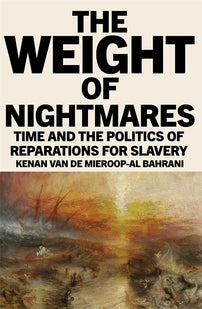
An excerpt from the introduction of Kenan Van De Mieroop-Al Bahrani's new book The Weight of Nightmares: Time and the Politics of Reparations for Slavery, out today.

I. A politics of time
Time can be a subject of political struggle that is every bit as contentious as the organization and distribution of space. But, whereas designations of space are usually understood to be historical artifacts and the product of, usually violent, conflict, the distribution of time is often spoken of or regarded as if it were natural. To be sure, geographical divisions are also habitually dressed up in the language of nature, a divine or cosmic destiny, yet it is widely understood that humans drew the lines that divide the world. It is less obvious that divisions of time are also amenable to manipulation. There are clear limits to humanity’s power over time; at least, if what we mean by time is what physicists mean when they discuss it as a parameter, or as spacetime. Time, in that sense, cannot be manipulated in a socially or politically meaningful way. We cannot turn it back, we cannot travel in it, and we certainly cannot make more of it. The empirical observation that time moves more slowly at sea-level than at the top of a mountain makes no difference to the way people live their lives. But, insofar as we are talking about time as a significant aspect of the symbolic world of human thought and action, time is configured and distributed. There can be multiple configurations and distributions of time which serve different ends, and these are always open and vulnerable to being further reconfigured and redistributed. It is precisely for this reason that one may speak of a politics of time; or of political struggle over the designation and enforcement of a particular temporality.
The significance of temporality was fully understood at what is often said to be the founding moment of modern politics: the French revolution. In 1793, a new Republican calendar was introduced retroactively declaring the previous year the first of a new era. The calendar, which was in use for almost thirteen years, was more than a symbolic gesture. In her detailed historical study, Sanja Perovic explains that the calendar was thought necessary precisely because it was understood that conceptions of time were a central source of legitimacy in the ancien régime. As she explains, “the Christian calendar subtended a vertical hierarchy consisting of three distinct social classes (those who toiled, those who prayed and those who fought).”[1]Before the revolution, almanacs and calendars synchronized sublunary affairs and inscribed agricultural activities, loan repayments, feast days and dynasties into a Christian cosmology and story of salvation.[2]Political institutions and the tasks of everyday life were coordinated and imbued with a broader significance and backed by what was thought of as a Divine plan. Founding a new society based upon new ideals therefore, required nothing less than overturning the temporality of the old regime. “For Gilbert Romme, the [Republican] calendar’s chief architect, the calendar marked the epoch when the history of the French Revolution converged with nature itself, when natural equality and the power of human beings over their own history became one and the same.”[3]
This episode reveals at least two important things about what I call the politics of time. First, the revolutionaries grasped a point, which one also finds in self-help books on time management that decorate the bookshelves at train stations and airports around the world today: in order to find true freedom, people must take charge of their own schedules. But this is much easier said than done, especially when confronted—as the French revolutionaries certainly were—with powerful forces of reaction.
Second, one of the most common tactics within the politics of time is to elide the difference between time and temporality. Powerful actors attempt to reify particular configurations and distributions of human time and present them as a matter of metaphysical principle. This kind of reification has the effect of limiting the scope of the politics of time and legitimizing a given order. The French revolution thus replaced a temporality rooted in appeals to Godly authority with one that was said to draw its mandate from nature itself.
But, as the example of the revolutionary calendar shows clearly, temporality is not fixed; it takes on different forms across times and cultures. This fact is well established in the field of anthropology—where the study of different cultures of time has been a significant topic of investigation—and in the discipline of history—where the cultural history of time has become the subject of renewed interest in recent years. European encounters with other cultures and their calendars animated a debate about the link between social orders and time in the eighteenth century and these discussions formed the background against which the Republican calendar was conceived.[4] In the twentieth century, E.E. Evans-Pritchard and Claude Lévi-Strauss showed the connection between patterns of economic and social life and concepts of time and history.[5] Albeit in a very different way to the French revolutionaries, the Nuer also used categories of time that connected and coordinated their social and economic activities with the demands of their environment. Their terms, Tot and Mei, denoted at once the dry and wet seasons of the year as well as the type of activities (agriculture, fishing, herding) to be undertaken during these periods. The time of day was noted by referring to habitual practices so that one might say, “I will return at (the time of) milking”.[6] These kinds of observations seemed to confirm Émile Durkheim’s insight that it was “the rhythm of social life which is at the basis of the category of time.”[7]
The fascination with exotic temporalities in the earlier part of the twentieth century was also motivated by an interest in how “social activities and structures” in Europe produced particular “time-values.”[8] Discourses about how other cultures relate to time became part of a broader constellation of ideas about the “modern West”. The idea that “the West” has had its own new and unique temporality in the form of “modernity”, and subsequently of “postmodernity”, is one of the most widely repeated and discussed propositions in the humanities. Most of the scholarly literature on cultures of time deals, in one way or another, with the vexed question of modernity. And one of the many contentious points in those discussions has been the historiographical problem of determining when exactly this new relationship to time emerged.
That debate has been shaped most significantly by the German conceptual historian Reinhart Koselleck.[9] His argument that a transformative period of European history— “Sattelzeit”—produced a qualitatively new, and generalized, experience of time—Neuzeit—continues to enjoy widespread appreciation even in light of the serious criticisms to which it has been subjected.[10] Before Sattelzeit, Christians understood the events of the world as being governed by an already fixed plan as outlined in the story of Creation, Incarnation, Christ’s Second Coming, and the Last Judgement. The future, meanwhile, was expected to be much like the past, and political events were seen as similar in kind, or parallel to events of the historical past. The idea that nothing fundamentally new ever happened was captured in the phrase from Ecclesiastes, nil novum sub sole, there is nothing new under the sun.[11] But this picture was undermined over the course of three centuries following the Reformation during which the End of the World was continually “prorogued”.[12] Political revolutions, social and economic upheaval and technological changes led people to begin to expect that the next generations would experience a fundamentally different world to the one their ancestors had lived in, or the one that they had known before. These factors combined to produce a split between the “space of experience” and the “horizon of expectation”—two metahistorical categories. If Robespierre could declare that the meaning of history is Progress and exhort his co-revolutionaries to hasten the pace of its coming, it was only because a previously dominant idea of time and history governed by providential design had already eroded.
[book-strip index="1" style="buy"]
François Hartog has elaborated upon this account of the history of time consciousness and extended it to the current era. He identifies three distinct regimes of historicity in “Western” culture.[13] In the first—the so called “ancien” or Christian regime of historicity—the space of experience seemed to coincide with the horizon of expectation, and the past was valorized as a source of authority and a repository of examples that could guide decisions in the present. The phrase Historia magistrate vitae, “History as life’s teacher” reflected an understating that knowledge of the past had a practical function. But the French Revolution gave birth to a new and modern regime of historicity in which—as Koselleck had already argued—this topos no longer seemed persuasive since the future was now expected to be substantially different to the past. Modernity was marked precisely by the belief in the possibility of making new futures and utopian visions of progress. Europe—at least certain parts of it—was said to be at the vanguard of history with a capital H, now understood as a collective singular process.[14] The future, not the past, became the new source of authority and legitimacy. Changes in the perception and “experience” of time were occasioned by upheavals in politics, society and economy that had taken place during the foregoing century and were reflected in a culture fascinated by new technologies and the phenomenon of time itself.
But as changes continued apace cracks began to emerge in the futurist regime as well. The dramatic events of the twentieth century expanded the gap between the space of experience and the horizon of expectation into a chasm so large that the future faded away from view. It now appears—to Hartog at least—that “we” are living in a continuous present; an omnipresent present saturated by a sense of confusion and disorientation. Under this presentist regime of historicity, acceleration has become so intense that it has generated a veritable crisis of time.
One of the “symptoms” of this temporal “malaise” is—Pierre Nora tells us—the widespread turn to “memory”. Desperate to find some sort of firm ground to hold onto amidst the slippage, many have sought to cling on to their collective memories. Now that all grand narratives have apparently been abandoned, people have turned their political interests to the past instead of attempting to project their hopes onto an uncertain future. Some insist that calls for reparations for slavery must be viewed within this context.[15]
Hartog’s account—along with much of the scholarship on modernity and postmodernity which it resembles—shares something in common with a great deal of self-help and time management literature. Such texts emphatically state that the perception and the reality that things are changing ever more quickly is the most important phenomenon in the world today. And they quite rightly note that this can be a source of great anxiety. But the explanations remain vague as to why these changes are occurring. There is a tendency to speak as though time is speeding up or accelerating of its own accord. When a cause for the rapid pace of change is mentioned, it is usually identified as “technology”, while, in the writings of Hartog and Koselleck, it is explained as a combination of new technologies and rapid political and social changes. But surely, these changes are themselves as much the result of the acceleration as they are its cause.
If the acceleration of (post)modernity is a sort of mysterious force or historical epoch that organically unfolded, there is nothing much that can be done about it. One can only resign oneself to it and hew to the imperatives of the changing times. But it is obviously not time itself that is speeding up, as Christophe Bouton notes, “[a]cceleration which is in its origin a central concept of Newtonian physics, is measured by time; it designates the augmentation of speed with respect to time. Therefore, time itself cannot accelerate because it would require another time in order to measure such an acceleration.”[16] So—to reformulate the question—if the acceleration is really one of the pace and intensity of human affairs, what explains it?
It is hardly a coincidence that almost all of the accounts that actually offer an explanation for this phenomenon are rooted in Marxian economic theory. This is not, as right-wing pundits would have us believe, because academia has been overrun by Marxists. It is, rather, a reflection of the fact that—in contrast to neo-classical economics which understands technology to be an exogenous factor in economic growth[17]—the Marxian framework coherently explains why capitalism is so technologically dynamic and disruptive. The coercive forces of competition drive capital to find new ways to augment the production of surplus value and profit. Technological change in the realms of production, circulation and consumption provides a competitive edge. This understanding underlies Fredric Jameson’s account of postmodernism as a cultural dominant that is connected to what he calls (following Ernest Mandel) late capitalism.[18] If, as David Harvey notes, there has been space-time compression, it is because changes in the production process and communication technologies have facilitated new modes of flexible accumulation.[19] Hartmut Rosa gives the most detailed explanation of the phenomenon of “social acceleration”, and identifies three “motors” that drive the process: these are cultural, sociocultural, and economic in nature. In the end, the drive to produce value in capitalism is the decisive factor.[20] Changes in the lived experiences of time at a given moment in European history had much to do with the subsumption of ever greater parts of the world into a new mode of production and distribution.
For many, if not most people, the “emergence” of the (post)modern experience of time might more accurately be described as an imposition. Moreover, declarations about the modern era were not merely descriptions of an observed reality, they were also performative statements. That is because modernity was always more than simply a chronological concept. Rather the “qualitatively new” temporality, of modernity involved the active “valorization of the historical (as opposed to the merely chronological) present over the past, as its negation and transcendence, and as the standpoint from which to periodize and understand history as a whole.” These words of Peter Osborne, reflect the view that modernity has a triple status as at once a declaration, a demand, and a command to “be modern.”[21] Looked at in this way, a new question emerges which is more manifestly a political one: who has articulated the injunction to be modern and why?
Is not modernity really what Paul Gilroy names the time of Paris, Berlin and London?[22] The phrase reminds us that the temporality of the metropoles was spread throughout the world by the rhythms of capitalist accumulation and imperial expansion. It was conveyed by trade, armies, technologies and given legal force by states. The time zones that divide the globe were instituted first by railroad companies before they were adopted in the International Meridian Conference of 1884. Time discipline was inculcated into the multitudeslabouring in the factory and on the plantation.[23] Alongside these processes, new forms of historical consciousness were promoted by nationalist ideologies and notions of citizenship.[24] Modern academic historiography was, at its inception, deeply bound up in projects of nation-building and took the geographical boundaries of nation states as its implicit spatial framework. Meanwhile, “[t]he modern ‘academic’ conception of time,” Chris Lorenz explains, “is a secularized version of the rectilinear, irreversible Christian time conception, stripped of its notion of an end and reduced to the idea of a structured process.”[25] There is,therefore, a sense in which the command to be modern has always meant conforming to what is expected of the citizen of a capitalist nation-state. It has also meant that millions have been placed outside of its geographical-temporal purview.
Understood as a category of time, (post)modernity must be a totalizing and universal experience. Understood as a description of a temporality, however, it is easier to see that the speed up and acceleration have not affected everyone in the same way.[26] This is well documented empirically. Judy Wajcman explains that experiences of time stress vary across groups and individuals, and that gender, class and ethnicity play no small role.[27] She recounts, for example, that studies reveal a “polarization of working time between those who work very long hours and others who work few or no hours….The fifty-plus hours week is…predominantly a characteristic of the professional and managerial class.”[28] While dual earner households where both partners work full time have become predominant in certain countries, domestic work and care still fall overwhelmingly on the shoulders of women. “Indeed, time-use data suggests that time poverty is a particularly widespread experience among working mothers, who juggle work, family and leisure.”[29] At the other end of the temporal spectrum, waiting and the overabundance of time pervade the lives of the unemployed and individuals pushed to the margins of processes of accumulation.[30] It is not hard to imagine that the billions of people in the global reserve army of labour are likely to have very different relationships to this temporal scheme.
If the lived time of individuals is diverse, the historical consciousness of modernity is, as post-colonial critics have already pointed out, also far from universal. Indeed, that may have been the point all along. Because, as Edward Said has argued, the construction of the identity of the “modern West” was facilitated by the articulation of that region’s fundamental difference and uniqueness vis-à-vis the rest of the world; a process that involved the designation of the non-West as the inferior and deficient opposite on multiple levels. One of those levels is that of time itself. The rest of the world was spoken and written about as non-modern, backward, decadent, or as Hegel said of Africa—remaining in a timeless state outside of history altogether.This temporal scheme provided a crucial justification for colonialism.
Claims to modernity were used to distinguish and separate certain groups from their contemporaries. Johannes Fabian famously argued that the discipline of anthropology as a whole was engaged in a practice of “allochronic” distancing of its subject, denying their “coevalness” with the “modern West”.[31] At the same time, Dipesh Chakrabarty claims, the “historicity” of the “West” remains the standard against which the history of all regions is measured.[32] This is even more clear in the discipline of economics, where belief in historical progress is alive and well, so that it is a matter of etiquette today to speak of “developing” and developed countries. The political implications of this terminology are that the rest of the world is behind the times and needs to play a game of catch-up in order to follow the West down the path it has forged.[33] The policy prescriptions of so-called development organizations based in Washington DC and other “Western” capitals are thereby endowed with an aura of historical destiny.
Meanwhile the notion that there is anything like the space of experience, in the singular, appears absurd in the light of the volumes of scholarship on “collective memory” which have documented the incredibly diverse mnemonic practices that proliferated in the past and continue today. Much of that literature had been devoted to explaining how the memory of slavery has been alternatively repressed, forgotten or recalled and passed down, through commemorative practices and “cultural trauma”.[34] Even within the geographical boundaries of the so-called West, modernity has always had its countercultures. Time was a central preoccupation among thinkers in the “Black Atlantic” who, to quote the inimitable Gilroy once again, “repudiated the heroic narrative of western civilization and used a philosophically informed approach to slavery in order to undermine the monumental time that supports it.”[35] Du Bois’ notion of “double consciousness”, Alain Locke’s exposition of the “New Negro”, the poetry of Langston Hughes, the paintings of Aaron Douglas, to Ralph Ellison’s concept of “invisibility”—in which one has a “different sense of time, you’re never quite on the beat”—and the Afrocentrism of Molefi Kete Asante, in which European modernity is re-narrated as an interlude in a broader history between an ancient African past and an Afrocentric future; all dealt with the problem of temporality. Sun Ra’s 1974 film Space is the Place is a powerful and insightful commentary on the on the dominant politics of time. Sun Ra is not born in time, he “arrives” in order to lift the youth of Oakland into a new historicity whose telos is an Afrofuturist utopia.
[book-strip index="2" style="buy"]
[1] Sanja Perovic, The Calendar in Revolutionary France: Perceptions of Time in Literature Culture Politics, Cambridge: Cambridge University Press, 2015, 37.
[2] Perovic notes the semantic connection between the word calendar and calendarium which means accounting book in Latin. Ibid., 24.
[3] Ibid., 1.
[4] Ibid., 26-33.
[5] E.E. Evans-Pritchard, “Nuer Time-Reckoning,” Africa: Journal of the International African Institute, vol. 12, no. 2, (1939), 189–216. Also see Alfred Gell, The Anthropology of Time: Cultural Constructions of Temporal Maps and Images, Oxford: Berg, 1992.
[6] Evans-Pritchard, “Nuer Time-Reckoning”, 207.
[7] Emile Durkheim (Trans. Joseph Ward Swain),The Elementary forms of Religious Life. London: George Allen & Unwin Ltd, 1915. Project Gutenberg November 13, 2012, [EBook], 440.
[8] Evans-Pritchard “Nuer Time-Reckoning,”, 189.
[9] On this question see also Zachary S. Schiffman, The Birth of the Past, Baltimore: Johns Hopkins University Press, 2011.
[10] Kathleen Davis, Periodization and Sovereignty How Ideas of Feudalism and Secularization Govern the Politics of Time,Philadelphia: University of Pennsylvania Press, 2012; Judith Pollmann, Memory in Early Modern Europe, 1500-1800, Oxford: Oxford University Press, 2017, especially the chapter “Past and Present: The Virtues of Anachronism”.
[11] Koselleck Futures Past, 133.
[12] Ibid., 22.
[13] He defines his key term as follows: “I defined ‘regime of historicity’ in two ways: in a restricted sense, as the way in which a given society approaches its past and reflects upon it; and in a broader sense, as ‘the modalities of self-consciousness that each and every society adopts in its constructions of time and its perceptions. To borrow Lévi-Strauss’s terms […], the notion refers to how a particular human community ‘reacts’ to a ‘degree of historicity’ which is the same in all societies. More specifically, it is a tool for comparing different types of history, and also (or above all, I would now say) for highlighting modes of relation to time, and exploring forms of temporal experience here and elsewhere, today and in the past—in short, it serves to explore ways of being in time”. François Hartog (Trans. S. Brown), Regimes of historicity: presentism and experiences of time, New York: Columbia University Press, 2015, 9.
[14] The idea that history should be understood as a “collective singular” process and replacing the notion of disparate histories occurred during the same period according to Koselleck. Ibid., 36.
[15] I elaborate and subject such accounts to critique in greater detail in chapter five of this book. There I show that the idea of reparations for slavery is presented as another symptom of the same phenomenon in this discourse. I have also discussed this point more extensively in “The ‘age of commemoration’ as a narrative construct: A critique of the discourse on the contemporary crisis of memory in France,” Rethinking History 22/2 (2016), 172-191.
[16] My translation. Christophe Bouton, L’Accélération de l’histoire: Des Lumières à l’Anthropocène, Paris: Seuil, 2022, 13.
[17] There are also endogenous theories of growth, for instance, the one associated with Paul Michael Romer.
[18]« Postmodernism or The Cultural Logic of Late Capitalism”, NLR I, 146, July- August 1984, 53-92.
[19] David Harvey, The Condition of Postmodernity: An Enquiry into the Origins of Cultural Change, Cambridge, MA: Blackwell, 1990. See especially chapter 17.
[20] Hartmut Rosa (Trans. Jonathan Trejo-Mathys), Social Acceleration: A New Theory of Modernity, New York: Columbia University Press, 2013, 162 and 194. See also Barbara Adam, “When Time Is Money: Contested Rationalities of Time in the Theory and Practice of Work.” Theoria: A Journal of Social and Political Theory, no. 102, 2003, 94–125. Bouton, who prefers to speak about the “acceleration of history” also emphasizes the importance of Marxian accounts of technological development. L’Accélération de l’histoire, 37-8.
[21] Peter Osborne, “Modernity is a Qualitative, Not a Chronological, Category,” New Left Review I/192 (1992), 73, and, “Global Modernity and the Contemporary: Two Categories of the Philosophy of Historical Time,” in Chris Lorenz and Berber Bevernage, eds.,Breaking up Time: Negotiating the Borders between Past and Present, Göttingen: Vandenhoeck & Ruprecht, 2013, 71.
[22] Paul Gilroy, The Black Atlantic: Modernity and double consciousness, London and New York: Verso, 1993, 197.
[23] E. P. Thompson, “Time, Work-Discipline, and Industrial Capitalism.” Past & Present, no. 38, 1967: 56–97; Mark Michael Smith, Mastered by the clock: Time, slavery, and freedom in the American South, University of North Carolina Press, 1997.
[24] Stefan Berger and Christoph Conrad, The Past as History: National Identity and Historical Consciousness in Modern Europe. London: Palgrave, 2015; Stefan Berger and Chris Lorenz, eds., Nationalizing the Past: Historians as Nation Builders in Modern Europe, London: Palgrave, 2010.
[25] “Unstuck in Time: the sudden presence of the past”, in Karin Tilmans, Frank van Vree and Jay Winter, eds., Performing the Past. Memory, History and Identity in Modern Europe. Amsterdam: Amsterdam University Press, 77.
[26] Jameson’s phrase, “cultural dominant” leaves space for this. Hartmut Rosa, meanwhile, insists that in analysing social acceleration he does not deny the diversity of temporal experiences, but nevertheless wants to focus on what he believes to be a powerful and central dynamic.
[27] Judy Wajcman, Pressed for Time: The Acceleration of Life in Digital Capitalism. Chicago: University of Chicago Press, 2015, 34. Furthermore, scholarship in disability studies has highlighted assumptions underpinning notions of temporality through the concept of “crip time”. Ellen Samuels “Six Ways of Looking at Crip Time,” Disability Studies Quarterly, Vol. 37 No. 3 (2017): Summer 2017.
[28] Ibid., 65.
[29] Wajcman, Pressed for Time, 66.
[30] A key issue in recent anthropological studies of time and inequality has been waiting. See, for example, June Hee Kwon, “The Work of Waiting: Love and Money in Korean Chinese Transnational Migration,” Cultural Anthropology 30, no. 3 (2015), 477–500; Craig Jeffery, Timepass: Youth, Class, and the Politics of Waiting in India, Stanford: Stanford University Press, 2010; Javier Auyero, Patients of the State: The Politics of Waiting in Argentina. Durham: Duke University Press, 2012; Daniel Mains, “Neoliberal Times: Progress, Boredom, and Shame among Young Men in Urban Ethiopia,” American Ethnologist, vol. 34, no. 4 (2007), 659–73.
[31] Johannes Fabian, Time and the other: How anthropology makes its object, New York: Columbia University Press, 2014, (First published 1983).
[32] Dipesh Chakrabarty, Provincializing Europe: Postcolonial Thought and Historical Difference, Princeton: Princeton University Press, 2008.
[33] I follow the argument made by Said and many others that the idea of a homogeneous and coherent “West” is a problematic concept for reasons too numerous to explain in a footnote. That is why I have thus far spoken about the so-called West or put the word in quotation marks. In order to make the text more readable however, I have chosen to use the term without quotation marks throughout the rest of the book.
[34] This is a very large body of literature. Some notable works include: James Oliver Horton, Slavery and Public History: The Tough Stuff of American Memory. New York: New Press 2006; Michel-Rolph Trouillot, Silencing the past: Power and the production of history, Boston: Beacon Press, 2015; Myriam Cottias, « L’oubli du passé contre la citoyenneté: troc et ressentiment à la Martinique (1848-1946) », in Fred Constant and Justin Daniel, eds., 1946-1996: cinquante ans de départementalisation outre-mer, Paris, L’Harmattan, 1997; Françoise Vèrges, La Mémoire Enchainée: questions sur l’esclavage, Paris: Albin Michel, 2006; Elizabeth Kowaleski Wallace, The British slave trade and public memory, New York: Columbia University Press, 2006; Ana Lucia Araujo, Public Memory of Slavery. Amherst, N.Y.: Cambria Press, 2010. Gloria Wekker, White innocence: Paradoxes of colonialism and race,Durham: Duke University Press, 2016; Esther Captain, "The selective forgetting and remodeling of the past: postcolonial legacies in the Netherlands,” in Stefan Jonsson and Julia Willén eds., Austere Histories in European Societies. London: Routledge, 2016, 73-87; Herman Ogoti Kiriama, The Legacy of Slavery in Coastal Kenya: Memory, Identity, and Heritage, Lanham, Maryland: Rowman & Littlefield, 2022; Ron Eyerman, Cultural trauma: Slavery and the formation of African American identity, Cambridge; Cambridge University Press, 2001. For a very important critique of the discourse on trauma see Wulf Kansteiner, "Genealogy of a category mistake: a critical intellectual history of the cultural trauma metaphor." Rethinking History 8.2 (2004), 193-221.
[35] Gilroy, Black Atlantic, 197.