Afshin Matin-Asgari and the Long History of US-Iran Relations
Eskandar Sadeghi-Boroujerdi sits down with Afshin Matin-Asgari to discuss the US's historic involvement in Iran.

For much of the past half century, writing on Iran–US relations has been structured by a narrow repertoire of explanations. At one end are accounts of misunderstanding and mistrust. At the other are narratives that reduce the relationship to a series of punctuated crises, most notably 1953 and 1979. What falls out of view in both cases is the longer history of power that binds these episodes together.
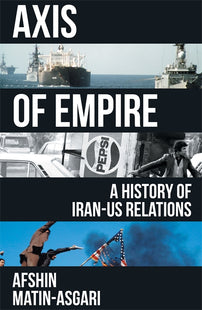
In Axis of Empire, Afshin Matin-Asgari reconstructs that history across two centuries. The argument is not that Iran–US relations have been uniquely conflictual, but that they have been structured by the expansion and consolidation of American power in the modern world. From early encounters mediated by missionaries and educators to the decisive reordering of the mid twentieth century, and from the construction of a Cold War client state to the long aftermath of revolution, what emerges is a relationship shaped not by contingency but by the enduring hierarchies of empire and capital.
At the same time, the book resists a simple opposition between empire and resistance. It situates the Islamic Republic within a contradictory field shaped by revolution, war, sanctions, and global imbalances of power. The question of anti-imperialism, often invoked and just as often dismissed, is treated here not as a slogan but as a historical problem. How it is articulated, by whom, and to what ends cannot be separated from the conditions under which it emerges.
At a moment marked by renewed war and escalating confrontation, Axis of Empire returns us to the longer history that has made the present intelligible. What we are witnessing is not an aberration but the latest phase in a sustained project of imperial violence, combining economic warfare, hybrid strategies, and the destruction of the critical infrastructure that underpins any capacity for developmental autonomy and self-determination, aimed at subordinating Iran to a US-led regional and global order.
Eskandar Sadeghi-Boroujerdi: You open by dismantling the “myth of auspicious beginnings” in Iran–US relations. What ideological work does this narrative perform, and why has it proven so durable across both academic and popular accounts?
Afshin Matin-Asgari: Myths of “auspicious beginnings” or initial “good intentions” are part and parcel of grand narratives apologizing for the blatantly malevolent trajectory of imperial history. All historical narratives impute meaning and normative valance to our understanding of the past. During moments of acute imperial crisis or failure, such as in the aftermath of the Iranian Revolution or the Vietnam War, sober historical narrators deploy the “tragic” mode, soon to be replaced by self-righteous imperialist narratives in both the academe and popular culture. As a rule, works written from a decidedly anti-imperialist perspective, such Axis of Empire, remain in the margins of mainstream historiography, a reflection of the ideological character of knowledge production.
ESB: Your central claim is that US policy toward Iran has been structured by enduring imperial priorities rather than miscalculation or misunderstanding. How does this reframe the overall trajectory of relations across the twentieth century?
AMA: As I explain below, US-Iran relations changed fundamentally when the American government became the main driver of interactions between the two countries during WWII. From that point to the present, US priorities in Iran have been clear, focused on oil, other commercial interests and geostrategic control through linkage to the Iranian military under the monarchy and systematic pressure to change the behaviour of post-revolutionary Iran via onerous economic sanctions, political and military pressure and now war. As we see in the current war, the American approach was never due to misunderstanding because there was always ample information about realities on both sides. Under the monarchy, Washington chose to ignore blatant evidence of the Shah’s unpopularity and his regime’s instability. After the 1979 revolution, all experts within and outside the government knew while the Islamic Republic defied America’s imperial designs, it posed no significant threat to the US or Israel, was not building a nuclear bomb and its regional policies at times coincided with Washington’s, for example in Iraq and Afghanistan.
ESB: In reconstructing the nineteenth century, you foreground missionaries, educators, and other non-state actors. How does this perspective complicate the conventional view that meaningful Iran–US relations begin only after the Second World War?
AMA: US-Iran relations began in early 19th century when private American citizens, i.e. Presbyterian missionaries, rather than governments, were the main link between the two countries. Failing to evangelize, the missionaries became the harbingers of American good will by providing modern education and health care in rural areas and remote provinces. A few Americans, most notably teacher Howard Baskerville and financial commissioner Morgan Shuster, left behind highly positive impressions as they took the popular nationalist side during the turn-of-the century Constitutional Revolution. The difference was that these Americans, like the missionaries, acted in their own private capacity and not on behalf of their government, which in fact opposed their intervention in Iran.
ESB: At the same time, you show that even in this early period, American actors were tied to commercial and strategic ambitions. Does this suggest more continuity than rupture between the missionary era and later forms of imperial engagement?
AMA: By early 20th century, Washington was taking the initiative to prioritize American business interests and systematically lobby for access to Iranian oil. In the wake of Presbyterian missionaries, American educators, art-dealers and archaeologists also made their mark by building cultural bridges, learning about Iran and introducing it to Americans back home. However, a qualitative change in relations occurred when the US joined the Allied occupation of Iran in WWII, making ties to the armed forces the main pillar of relations. This was familiar US imperialist strategy, hitherto practiced in the Western Hemisphere and extended across the globe after WWII. Iran’s oil and geostrategic location, between the USSR and the Persian Gulf, made it a prize in the Cold War, an asset to be held as British control of Iran waned facing the rising tide of indigenous nationalism and communism. During the 1940s, Washington posed as a disinterested third-party, mediating between Iranian nationalist aspirations and Anglo-Soviet interference. But the CIA’s intervention in the 1953 overthrow of Iran’s nationalist government shattered the illusions of American neutrality.
ESB: Your account of the 1953 coup resists reducing it to either external imposition or internal collapse. How should we think about the articulation between imperial intervention and the fragmentation of Iran’s political field in producing that outcome?
AMA: Describing the runup to the 1953 coup, and throughout the book, my narrative emphasizes the agency and responsibility of Iranian actors in their engagement with the American imperial hegemon. Thus, my account of superpower intervention in post-WWII Iran is different from typical narratives in several respects. First, I locate the origins of the oil nationalization campaign in working class struggles of 1920s, two decades prior to its famous articulation by Mosaddeq’s middle-class National Front coalition. Second, I criticize Mosaddeq’s failure to recognize that both Truman and Eisenhower administrations acted to undermine him during the oil nationalization dispute with the UK. Truman’s outward gesture of support for Mosaddeq was meant to loosen the British monopoly of Iranian oil and carve out a space for an American share in Iranian oil. Nor did Mosaddeq have a proper strategy for building an effective party-based nationalist movement or mange relations with the communist Tudeh Party and the Soviet Union. Last but not least, he failed to end or even curtail intimate American ties to Iran’s armed forces, leaving intact the instrument Washington would use to bring about his demise in 1953.
ESB: You describe post-1953 Iran as a Cold War client state. In what sense was Iran actively reorganised within a wider US-led architecture of power spanning security, political economy, and culture?
AMA: Following Mosaddeq’s overthrow, America became the imperial hegemon in Iran, where it built a monarchist client state during the 1950s-1960s. But US relations with the Shah changed over time and included tensions and discord. The Shah was never a Washington’s mere “puppet,” whatever that term might mean. One thing, however, remained constant, namely that successive Republican and Democratic administrations, from Eisenhower to Carter, supported the Shah’s increasingly autocratic rule, while steadily expanding the kind of economic, political, cultural and military ties to Iran that served American imperil interests. US corporations, from Pepsi to IBM, and more importantly the military industrial complex, profited immensely from Iran’s oil income being recycled to the US, mostly in the form of the Shah’s massive arms purchases. Meanwhile, US cultural imperialism made deep inroads via the Americanization of Iran’s educational system, elite acculturation, book publishing, and popular culture manipulation via film and television.
ESB: Your reading of the Shah’s later period suggests that US-backed modernization intensified structural contradictions rather than resolving them. Which tensions proved decisive in pushing the system toward revolutionary rupture?
AMA: Axis of Empire discusses how 1960s-1970s Iran became a veritable laboratory for American-style modernization theory, whose gurus, Walt Rostow and Samuel Huntington, approved its dictatorial implementation by the Shah’s regime. In the Nixon-Kissinger era (1968-1974), Iran’s “special relation” with Washington reached its peak, with the Shah spending billions on US armaments and acting, per the Nixon Doctrine, as the “gendarme of the Gulf,” aligning with Israel and military intervening in neighbouring countries like Iraq and Oman. At the same time, Washington condoned and encouraged the Shah’s brutal repression of dissent and opposition, a policy that systematically blocked the path of peaceful and legal and change, thus paving the way for the revolutionary explosion of pent-up political grievances.
ESB: In your account, the Islamic Republic’s anti-imperialism is often treated critically, particularly in its state-centred form. But how do you explain the origins of that anti-imperialism in the revolutionary moment itself, where anti-American sentiment was not simply imposed from above but expressed through genuinely popular demands? To what extent can it be reduced to an instrumental strategy for consolidating power, and where does that explanation fall short?
AMA: On this question, my view diverges from leftist perspectives that prioritize anti-imperialism as the ultimate benchmark to evaluate political regimes. Axis of Empire traces primary sources to show that from its 1979 inception, the Islamic Republic was both anti-imperialist and reactionary. This take on the Iranian Revolution emerged in Iranian left circles during 1979-1980 and was echoed by Fred Halliday, the leading international Marxist expert on Iran who was closely affiliated with NLR. In fact, Halliday went as far as calling the Islamic Republic “fascist” and its contention with the US “the anti-imperialism of fools.” Chapter 5 of Axis of Empire shows how, during its first year, the Islamic Republic fashioned a constitutional dictatorship where absolute power was held by a Supreme Leader, Ayatollah Khomeini, presiding over unelected clerical institutions superimposed on a republican state frame. This was the outcome of intense post-revolutionary struggles whereby the fledgling Islamic Republic crushed the freedom of press and association, workers councils, autonomous ethnic minorities, and women’s rights. A turning point ushering the regime’s peculiar anti-imperialist posture was the November 1979 seizure of the American embassy in Tehran. While some leftists hailed this as a great anti-imperialist move, others saw it as a project of domestic power consolidation, diverting the revolution from its socially emancipatory agenda toward an existential face-off with global hegemony.
In the long run, the Hostage Crisis proved enormously damaging to Iran, starting the US economic sanctions regime that is still in place, while internationally isolating the revolution, allowing Iraq to invade Iran and plunge the country into eight years of destructive war. The war further solidified the Islamic Republic into a military-security state that brutally wiped out all dissent, killing thousands of Islamic and secular leftists during the early 1980s and in the war’s immediate aftermath in 1988. The regime’s militarization intensified in the post-Khomeini decades when the Revolutionary Guards became its backbone and most powerful shareholder in Iran’s crony capitalist system. The Guards reaped tremendous financial rewards by managing a black-market economy that systematically bypassed the sanctions which for decades choked the people’s livelihood. Repeated grassroots and civil society attempts at peacefully reforming the system were crushed violently by the state’s repressive organs, particularly the Basij militia tied to Revolutionary Guards, killing thousands of Iranians in 1999, 2009, 2018-2019, 2022-2023, and recently in January 2026. Tens of thousands of dissidents have been imprisoned and tortured during the past five decades. If impressed by the Revolutionary Guards’ current effective resistance to US-Israeli aggression against Iran, we should remember the bloody repression the Iranian people continue to endure under a regime that now seems to be a military dictatorship by the Guards.
ESB: How do you assess the Islamic Republic’s claim to anti-imperialism. How should we understand its material and ideological support for causes such as Palestine within your broader framework?
AMA: First, morally and politically, the Islamic Republic’s support of the Palestinian cause, whether genuine or out of other considerations, does not allow us to ignore or downplay the regime’s systematic and brutal repression of its own citizens. Second, the Islamic Republic’s grand strategy of defying Israel, by building a regional “Axis of Resistance,” could not change the material conditions of occupation, prevent genocidal Zionist attacks on Palestinians and Lebanese, or deter Israel from invading Iran. Prior to 7 October 2023, Iran had helped construct an Axis of Resistance around Israel, forging military ties to Palestinian organizations like Hamas, Lebanon’s Shi’i Hezbollah militia and the Bashar Assad regime in Syria. The assumption in Tehran was for this military ring to bolster Palestinian, Lebanese and Syrian resistance to Israeli aggression, while acting as deterrence to Israel’s ultimate objective of invading Iran and overthrowing the Islamic Republic. After 7 October, Israel’s ferocious and genocidal onslaught, and Assad’s collapse in Syria, rendered the Axis of Resistance largely dismantled or diminished. Meanwhile, Tehran’s direct military support of Hamas and Hezbollah bolstered false Israeli claims branding them Iranian proxies. Nor did the Axis of Resistance project ever receive meaningful popular endorsement in Iran where many saw it as a failed venture draining the country’s depleted resources without any tangible benefits, not even to Palestinians.
ESB: If we read the War on Terror alongside President George W. Bush’s 2002 “axis of evil” speech, which explicitly named Iran as a target of US policy, do they not point to a single strategic horizon in which the Islamic Republic remained an object of pressure and possible overthrow. To what extent was regime change deferred rather than abandoned as the United States became mired in Iraq and Afghanistan?
AMA: As the book shows, I don’t see the long arc of US-Iran relations as the playing out of a regime change script hatched by Israel and deferred by successive American administrations, preoccupied with interventions in Iraq and Afghanistan, until its implementation by Trump. Regime change in Tehran has been a repeatedly stated Israeli goal since the 1990s, but not always a US objective, as evidenced by Obama’s deal-making with Tehran. The inexorable regime change scenario ignores another important factor, namely that the Islamic Republic’s behaviour makes a difference. While Tel Aviv and Washington are the main purveyors of aggression against Iran, the Islamic Republic too has committed strategic blunders. It obliged Israel by playing the boogieman role assigned to it, pursuing a policy of nuclear ambiguity toward bomb-building capability, building military presence on Israel’s borders and developing a ballistic missiles program threatening not only Israel but all of Iran’s neighbours and even European targets. The current war shows Iran’s most effective grand strategy is to defend itself within or adjacent to its borders, closing the Strait of Hormuz and hitting back at US bases in the Gulf states. Meanwhile, Iran’s air space has been open to American and Israeli planes to bomb at will, destroy the country’s civilian and military infrastructure and murder its citizens in their homes, schools and workplace. The aerial bombardment of urban populations is a war crime, but the Islamic Republic too bears a measure of responsibility for failing to protect its population from being slaughtered from the air.
ESB: You present the JCPOA as a rare moment of negotiated accommodation. What conditions made that agreement possible, and how should we understand both its subsequent collapse and the Trump administration’s shift to “maximum pressure.” Do these developments reveal the limits of diplomacy where US policy continues to rely on sanctions, economic warfare, and coordination with Israeli power in the region?
AMA: The JCPOA was accomplished despite intense opposition by Israel and its American lobby, displaying a rare moment when this lobby was defeated in Washington. Significantly, it showed diplomacy and negotiations with Iran can work, even if their result might be overturned by the next US administration returning to sanctions and the war path. At the same time, recent US-Iran negotiations, during the summer of 2025 and February 2026, were meaningless and a cover for war. Instead of trusting these negotiations, especially in last February, Iran should have taken unilateral measures to pre-empt US-Israeli excuses for war, for example declaring a halt to uranium enrichments, something that was effectively stopped anyway. The ceasefire in the current US-Iran war, something Israel desperately tries to break, is obviously the result of direct and indirect negotiations. The war has been a strategic defeat for both Israel and the US, hence the possibility of a negotiated US-Iran agreement favouring Tehran. That too could prove temporary, as all agreements in international relations are. A progressive perspective, however, should focus not on the gains and losses of state actors, but on preventing, or at least minimizing, any war’s toll and damage to civilian populations, in this case the people of Iran and Lebanon.
ESB: The justifications for the current US–Israeli war on Iran have shifted repeatedly, from regime change to nuclear proliferation and missile capabilities. What do these changing rationales reveal about the underlying objectives of the war. More fundamentally, how should we understand its driving forces. Do you see it as the product of longer-standing imperatives of US imperial power in the region, or as significantly shaped by Israeli interests and influence in Washington, as many commentators now argue? How does this debate sit with the broader framework of your book?
AMA: There is now almost unanimous consensus that prime minister Netanyahu prevailed upon Trump to go to war with Iran. Thus, Israel finally achieved the goal it had persistently pursued for three decades. Many if not most observers also agree that for decades Israel has been the most powerful actor shaping US policy in the Middle East. At the same time, we see growing recognition, in US Congress, foreign policy establishment, media and among the public, that unconditional support of Israel is detrimental to American interests, no matter how they are defined. This sentiment is spreading exponentially in the wake of the current war and is now shared even by segments of Trump’s MAGA base. The war with Iran has acutely exposed a dangerous faultline in the architecture of America’s global imperial standing, whereby a bellicose elite repeatedly has dragged the country into failed military engagements in Iraq, Afghanistan, Iran, the Persian Gulf states and Lebanon. Israel has been involved in all these ventures, often acting as the blunt instrument of the American empire, though it also has its own specific agenda, i.e., upholding a genocidal apartheid state at any cost. Given the failure of the current US-Israeli war against Iran, we have reached an historical inflection point where American imperial hubris and overreach has disrupted the global economy and Washington’s relations with its Gulf region and NATO allies, with Russia and China waiting in the wings to exploit America’s loosening grip in the axis of its empire in the Middle East.
Book strip #1
-
 30% off
Behind Enemy Lies
-
 30% off
Axis of Empire
-
 30% off
Unholy Kingdom
Book strip #2
-
 30% off
Road to October 7
-
 30% off
Homeland
-
 30% off
Friends of Israel
