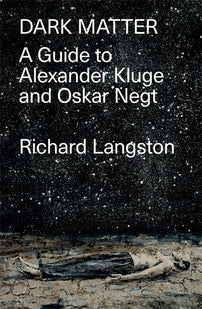
Alexander Kluge (1932-2026)
Alexander Kluge is Dead—Long Live the Bauhaus of Subjective Experience

Who was Alexander Kluge and how are we best to remember him? Was he a multimedia artist or the very last renaissance man? A social theoretician or the Frankfurt School’s court poet? A raconteur of astonishing creativity and breadth or a savvy media producer attuned to the metamorphoses of late modernity’s public spheres of production?
Kluge wore, of course, all these hats and many more. Yet he insisted all along and in the most modest of ways that he was nothing more than just a storyteller. Cave paintings, the burning of the Library of Alexandria and modernism’s great chroniclers (e.g., Thomas Mann, Marcel Proust and Robert Musil) were just a few of the many reasons why storytelling remained the common denominator in all his work. With storytelling, Kluge sought to impart a keen sense of historical depth to the shallows of contemporary social experience. Without a sense of history, our impoverished modern experience would be devoid of orientation and thus doomed to continue its collision course.
So, it’s not accurate to say that Kluge wanted everything. In truth, he simply wanted us—humanity—to want to work on achieving the conditions necessary for attaining genuine happiness, the good life that capital ensures is perpetually beyond our grasp. That work was for him nothing less than trying to think together with others in spite of all our differences. Happiness or what Kluge’s mentor Theodor W. Adorno (borrowing from Stendhal) called the promesse du bonheur is invariably a collective undertaking, one that requires a healthy dose of fantasy, theory, labor, myriad aesthetic forms and, above all, patience. Kluge never dared to define this good life for others, but he did insist nevertheless that utopia always gets better the longer we wait for it. The key, of course, is to remain committed to the collective work while we’re waiting, So, no, Kluge was not the enlightener. He didn’t have answers for fixing all the many pressing problems of the day. Rather, he had an endless supply of questions using astonishingly unusual mediums for assisting us with the task of orienting ourselves critically vis-à-vis contemporary problems: avant-garde montage, the circus, A.I., the Thirty Years’ War, the cinema of attraction’s minute films, Marx’s Capital, opera, the Battle of Stalingrad, cellphones, astrophysics, etc.. There was seemingly nothing Kluge couldn’t subsume into his toolbox; within a single work he could accommodate, in fact, an entire galaxy of ideas. If there is such a thing as true happiness, then it might possibly emerge when we work through a massive, unruly archive of human experience like the one Kluge collected in solitude and together with others.
Kluge gave us one the most unique, prodigious and sophisticated bodies of creative work ever produced by a single individual. In this respect, he was and will likely remain peerless. His greatness was, however, inconceivable without the multitude of collaborators who helped to execute his vision, inspire his creativity and extend his reach. To name only Oskar Negt, Sarah Morris, Heiner Müller, Katharina Grosse, Gerhard Richter, Kerstin Brätsch, Georg Baselitz, Anna Viebrock, Anselm Kiefer, Hannelore Hoger, Helge Schneider, Lilith Stangenberg and Christoph Schlingensief is to neglect his many other loyal collaborators. Many were famous in their own way. Others worked diligently behind the scenes in Münich, Düsseldorf, Berlin, Frankfurt, Bielefeld, Tokyo, New Delhi, Ithaca and elsewhere. Solitary perches like Schloss Elmau in the Bavarian Alps were as important for Kluge’s writing as the movie camera, the telephone, the Internet, Skype and the museum were for his countless collaborations over his sixty-six-year career. The result is millions of images, thousands of stories and televised interviews and hundreds of films and books translated into sundry languages, many of which have been transposed into new contexts and folded into new constellations.
[book-strip index="1"]
Whereas early Kluge wrestled with the disastrous outcomes of twentieth-century German history, late Kluge pivoted to themes more transnational, planetary and cosmic in scope. As Germany became less geopolitically consequential in the new millennium, the importance of dialogue beyond Europe grew in importance for him as well. Accordingly, the Americas, Asia, Africa and the Antipodes commanded his attention more and more. Sadly, Kluge’s signature theme, war, refused to recede into the horizon of human experience within his lifetime. Since 2000, his preferred métiers included not only storybooks but also films fleeting, classical and maximalist in scope, web domains and museum exhibitions. Even when his quirky late-night transmissions came to an end after thirty years on German cable television (1988-2018), he continued making films both long and short on a weekly basis. With the arrival of generative artificial intelligence in 2022, Kluge’s muse found yet again new inspiration for how to reinvigorate cinema. His passion for conceptual thought showed no signs of waning either. The poetic power of theory, Immanuel Kant’s thought in the twenty-first century, the long history of Caesarism and the subjunctive mood of cinema were just some of the theoretical concerns to which he devoted considerable time and attention.
If there was one leitmotif in my many Zoom conversations with Kluge over the past year to which he and I returned repeatedly, then it was what he called a “Bauhaus of subjective experience.” In his 2025 book Aus dem Bauhaus der Natur, Kluge implored, “We need a ‘Bauhaus of emotions.’” “The interior furnishings inside us human beings,” he explained, “i.e., the enclosure of our psychic constitution and its arrangement, the interplay of objectivity and emotion and the constitution of a ‘public sphere saturated with subjective experience’ are at stake today.” Why? Because the burgeoning world of algorithms, along with the attendant power of its facticity, has unleashed a new unprecedented phase in what Georg Simmel long ago called the “tragedy of culture,” what Max Weber named “rationalization” and what Georg Lukács referred to as “reification.” Kluge repeated his injunction in conjunction with his 2026 Viennese retrospective and he mentioned it even in his interview about Habermas’ legacy published just days before his own death. For Kluge, a Bauhaus of subjective experience refers not to an institution per se but rather to a conceptual project yet to be realized. Walter Benjamin arguably described such a project’s task best when he insisted on a “new, positive concept of barbarism. For what does poverty of experience do for the barbarian? It forces him to start from scratch.” Starting from scratch in the age of big data would require input from an outsized creative collective; image and music makers, storytellers and theoreticians would constitute its nucleus. “You can’t narrate [this Bauhaus] using words alone,” Kluge explained, “you also need images that bump up against words. You need mourning and that’s achieved with music. You therefore need all these synoptic and emotional forms.” This new Bauhaus project would necessarily require the freedom of liminal, transnational spaces beyond the reach of any one single national public sphere. Kluge always imaged a place somewhere along the transatlantic bridge spanning Europe and the Americas where this work would transpire. And it would also responsibly undercut its own Brahminical proclivities by productively engaging with the phantasmagorias of bygone world’s fairs and their present-day reincarnations. Membership would require neither an audition, nor completion of a preliminary course or workshop training. A Bauhaus of subjective experience merely requires its adherents to “build coral reefs, form groups, and develop attractions.” Rich subjective experience emerges when its arbiters come together and commit themselves to building oases where counter-public spheres can take root.
For some, Kluge seemed like he would live forever. For others, his remarkable longevity was reason to disparage what looked on the surface like more of the same. Uncertain whether any given call would be our last, I never took ourconversations for granted. Every exchange with him was an extraordinary gift, for his generous way of thinking always took us to the most unexpected and enlightening of places. Thinking together with Kluge aloud was incredibly humbling, deeply generative, politically urgent and always more than just a tad humorous. Whether those of us privileged enough to talk with him more than once can take up his example remains to be seen. Certain, however, is the fact that Kluge left us with countless examples from which we may learn. Truth be told, Kluge always knew he was up against the clock and for that reason he was astonishingly productive. The beautiful work of art and the attendant pursuit of perfection were alien to him. Collaboration ensured the greatest of speed. When misused correctly, technology ensured that new forms could reach considerable audiences while also triggering the critique necessary for potentially finding ways out of our troubled age.
With Kluge’s passing, an entire generation of Frankfurt School thinkers is now gone. How fitting that the Frankfurt School’s court poet-cum-jester was the last to go. With Jürgen Habermas’ departure a mere twelve days earlier, Kluge’s passion for commenting on Critical Theory writ large in both word and image could finally take its own leave. And now we are left to make sense of Kluge’s legacy, to answer its call and realize his outlines for a Bauhaus of subjective experience.
Alexander Kluge passed away in Munich, Germany, on March 25, 2026.