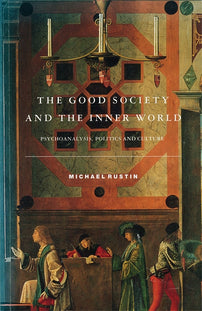
“The Good Society and the Inner World” at Thirty-Five
David K. Seitz revisits Michael Rustin’s Braiding of Socialist Politics with Kleinian Psychoanalysis

The first chapter of sociologist Michael Rustin’s The Good Society and the Inner World opens autobiographically, positioning its author at the interstices of two possibly incommensurable worlds.
I have regarded myself for many years as a socialist,” Rustin begins. “For a lesser number of years, I have also been considerably influenced by psychoanalytic ideas of a largely Kleinian kind, through reading, through a personal analysis, and through a continuing acquaintance with my wife’s work as a psychotherapist. The issue is: what, if any, is the relationship between these two powerful perspectives? Are they compatible or not? Do they tend in the same or in inconsistent directions? This issue perhaps has a more than personal interest.
When Rustin speculates that his predicament might hold “more than personal interest,” he is surely being modest. Attempts to “braid” Marx and Freud, remarks historian Hannah Zeavin, may often result in “a failed braiding,” but “failure is not only bad, it can be productive,” holding out the prospect of a “unified theory of unhappiness, not so ordinary, but also ordinary.” There remains for many of us an abiding sense that both projects need something from the other: that the Left needs more complex understandings human subjectivity in overcoming economism and didacticism, and that the premise of free association remains more radical than many dominant incarnations of psychoanalysis can permit. For some, Rustin’s assertion that “It is still an open question, in the case of psychoanalysis, what its ultimately most important political affiliations will be,” may prove too generous to psychoanalysis. And yet that very assertion also keeps open the possibility of Zeavin’s productive failures.
Many efforts to hold these worlds in tension work with Freud or Lacan, reading these prolific and ever-evolving thinkers for their self-contradictions and against their sometimes-bourgeois inclinations. Other worthy efforts refuse Eurocentric genealogies of psychoanalysis altogether, as does psychologist Lara Sheehi in her remarkable recent book, From the Clinic to the Streets, which instead begins with the revolutionary Martinican psychiatrist Frantz Fanon.
But Melanie Klein’s is a name that comes up somewhat less often in efforts to forge a Left psychoanalysis. Born in Vienna in 1882, Klein spent the better part of her career in London, where she moved in 1926, and was a leading figure in what became known as the British object-relations school of psychoanalysis until her death in 1960. Among what psychologist Janet Sayers memorably called the “mothers of psychoanalysis,” Klein inspired second-wave feminists like the sociologist Nancy Chodorow, and has more recently become influential in queer studies, where her core concept of reparation continues to elicit considerable controversy via the work of literary scholar Eve Kosofsky Sedgwick. Yet explicitly socialist engagements with Klein’s work, like Rustin’s, remain somewhat rare.[1]
The Good Society and the Inner World turns thirty-five years old this month – an age that also comprises the threshold for both the current medical definition of advanced maternal age and eligibility for election to the U.S. presidency. Given Klein’s abiding interest in the mother-child dyad as a formative scene of psychic life and Rustin’s curiosity about “the social and political affiliations of Kleinian psychoanalysis,” perhaps thirty-five years marks an apt, more than coincidental occasion to revisit this book. Although Rustin is focused on psychoanalytic institutions and Left politics in Britain, I invoke the U.S. presidency, tongue firmly in cheek, to mark my own curiosity as an American socialist with a longstanding interest in Klein about how Rustin’s insights might travel across space as well as time. Accordingly, it is to his political essays, which comprise the first third of the book, that I devote most attention.
[book-strip index="1" style="buy"]
Rustin turns to Melanie Klein in search of a more layered, social view of the human subject, seeking an alternative to both a too-neat Left social constructivism and the neoliberal individualist accounts of human nature on the ascendant in the age of Thatcher. In Rustin’s view, what distinguishes the Kleinian school from other psychoanalytic traditions is its emphasis, informed by Klein’s clinical observations in play therapy with children, on human subjectivity as “the emergent result of a prolonged and delicate process of dependency.”
For Klein, dependence means we are relational creatures from the start—and crucially, that relationality is hardly a uniformly benign, cuddly affair. In Klein’s “distinctively uncompromising view of human destructiveness,” Rustin explains, the terrifying fact of initial dependence gives rise to an infant’s destructive, often unconscious feelings of aggression, envy, greed, and rage toward a phantasy image of the primary caregiver – the first “object” in “object-relations.” At pains to make sense of contradictory, incoherent sensations and feelings, the infant struggles to imagine that caregiver as a whole, separate, imperfect being, instead idealizing some parts of the caregiver as beneficent while reviling others as corrupt and persecutory. In Klein’s lexicon, this frantic splitting exemplifies the “paranoid-schizoid” psychic position. Gradually, and never completely, infants come to reconcile these bifurcated images with their caregivers’ reality—to take responsibility for their aggression and fashion a more realistic unconscious image of a flawed but loved whole object. Klein calls this process “reparation,” which can only be successfully undertaken from a different, “depressive” psychic position. Rustin thus identifies “a hopefulness in the Kleinian account”. Dependence on others engenders hostility and destructive envy, but also remorse, concern, and love. We live with the tension between those (mostly unconscious) feelings – between the paranoid-schizoid and depressive positions – throughout our lives.
Presented with this capsule account, it is both unsurprising and understandable that Klein and her followers are sometimes criticized for an overly essentialist, universalizing, and biological view of the human. Klein effectively displaced the primacy of the Oedipal “mommy-daddy-me” triad familiar to readers of Freud, a move that continues to inform feminist and queer interest in her work. But her shift in emphasis to the mother-child relationship as the crucible of human development—a point on which classical Kleinians could be quite doctrinaire—risks inscribing its own particular scene of kinship and gendered labor as definitive of all humanity. Many who build on Klein emphasize the openness of “mothering” as a category to people of all genders, and I used “primary caregiver” above in that spirit. But insofar as these tweaks in language still assume an ideal, natural form of kinship from which some might deviate, they are surely inadequate in and of themselves, as Judith Butler has pointed out.
And yet Rustin models an approach to Klein that seeks not so much a one-size-fits all model of kinship as insight into dependence as a psychic predicament that is at once socially contoured and inexorable. “The task of providing care, membership and identity in society,” he advises, “plainly cannot be met through the restoration of some religious or ideological myth of the family” (38). Instead of a “regressive” renewal of the family romance, he calls for a creative political extrapolation from Klein’s work, such that “commitments to the processes of familial relationship found in object-relations… enrich socialist ideas of what should be asked of wider relationships and institutions” (38). By placing dependence at the center of his theory, Rustin arrives at something like psychoanalytic corollary of socialist feminist theories of social reproduction, calling for a politics that values relationality and care without falling into the trap of sentimentalizing them.
[book-strip index="2" style="buy"]
Dependence is, of course, also a familiar term for the radical Left in a related but distinct register. Anticolonial revolutionaries like Walter Rodney write of imperialism as engendering “a vicious circle of exploitation and dependence,” advocating for the rupture of the contingent forms of dependence induced by colonial capitalist power. Surely, when dependence is induced on oppressive terms—by extractive colonizers, repressive family members, exploitative bosses, greedy landlords, invasive case workers, or murderous police—the best response is not for the dependent subject to make Kleinian reparation for resenting their oppressors. Domination can also conceal more structural dependences running in the opposite direction, as in the capitalist’s dependence on labor and rent, the core’s dependence on the periphery, the patriarchal household’s dependence on gendered labor, and so on. Life’s fragility and uncertainty, and our dependence on others in bearing it, can be organized in ways that are more or less exploitative, more or less maldistributed. Butler has developed an argument along these very lines in works like Frames of War, and it resounds, too, in Ruth Wilson Gilmore’s definition of racism as “state-sanctioned and/or extralegal production of group differentiated vulnerabilities to premature death”.
But even in the best of all possible worlds, in which death, dependence, and psychic distress would not be so maldistributed, none can be fully escaped. However much one might take problem with the biologizing streak in Klein, one cannot critique or fight one’s way out of dependence altogether. For Rustin, “socialist theory must take account of these facts and construct a frame of meanings – a theodicy – with which we can face them”. The Left’s task, as he sees it, is to offer an alternative politics that meets the challenges of its own historical conjuncture, tracking how reactionary and individualist ideologies exacerbate and exploit the psychic predicament of dependence and the idealizations and resentments it can set in motion.
Rustin grants that “these are un-utopian assertions,” but insists that they are “needed if socialism is to face up to its present ideological crisis”. His words resound in our own historical time, mired as we often are in a bad dialectic between neoliberalism with the thinnest of progressive veneers, on the one hand, and open fascism, on the other. Leftists depend materially and psychically on our comrades, fighting to win a better world, keeping each other alive, struggling it out—and at times, disappointing each other. We depend on ideals that provide alternate horizons to capitalist realism, and summon the collective will to risk appearing ridiculous in seeking their realization. We depend on strategies that may fail us, the successes and failures of which we may or may not learn. We may depend on institutions for various forms of provisioning or limited legal protections, even as we also ruthlessly criticize their contradictions. And we depend on increasingly compromised ecologies and fragile infrastructures for our very lives. Some of the objects, to use Klein’s terms, on which we may depend in this perilous moment are not worth repairing. But others are, even and precisely as none of these objects are ever ideal.
Hardly a utopian, then, Rustin nevertheless also finds “a utopian content in object-relations theory: a commitment to the value of life, of relationship, of membership in a social community from birth, of creative development, and of a normal care for others, which properly form part of a socialist conception of humankind”.[2] It is in this more utopian vein that Rustin asks what psychoanalysis as a clinical practice might broadly contribute to a good society, building on the key role of British psychoanalysts in the formation of the post-war welfare state. But Rustin knows very well that “if socialists are to recover a capacity to define a new shape for the future,” we must go well beyond “the defence of the institutions of the welfare state”. Refusing the resigned, bourgeois view of analysis as “merely a privilege that only a minority could possibly have,” he asks how, “the non-availability of psycho-analysis” could itself “be considered an injustice,” and offers an expansive definition of “justice as the provision of opportunities for emotional and psychic, as well as other kinds of development”. What would it mean, Rustin asks, for middle-class psychoanalysts to embrace their profession’s oppositional political potential, and their potential “affinities with social forces demanding more generous and egalitarian social services”?
In a way, Rustin begins to anticipate Fredric Jameson’s provocative thought experiment in An American Utopia, inspired by a science fiction short story by Terry Bisson in which the United States achieves universal social citizenship not through conventional political means, but through universal conscription into the Army, among the last bastions of the American welfare state. Jameson proposes a universal welfare institution, the Psychoanalytic Placement Bureau, to organize everything from labor to market research to polling to healthcare to psychoanalysis, with the state eventually “withering away into some enormous group therapy”.[3] Among the key tasks of clinical psychoanalysis, so envisioned, would be to enable patients to enjoy rather than enact their mounting envy of others’ “outrageous self-indulgences and personal freedoms,” which Jameson expects would not abate but proliferate in a society emancipated from material inequality.[4]
[book-strip index="3" style="buy"]
Rustin stops short of proposing traditional, five-day-a-week psychoanalysis for all, citing the sheer labor-intensity of such an endeavor. And yet he shares with Jameson a curiosity about how to expand on the precedents established by prior expansions of social citizenship. For Jameson, this example comes from G.I. Bill’s extension of health, housing, and educational benefits to (most) veterans in the United States. For Rustin, “The National Health Service, with all its imperfections and attrition, is still the finest practical example in this country of an attempt to assert… a minimum condition of citizenship as one necessary condition for making possible individual experience”. To be sure, Rustin’s claim about the NHS does not obtain to the same degree after decades of consequent and compounding austerity and privatization. But when Julia Kristeva worries that critics like Rustin and his wife and collaborator, the psychotherapist Margaret Rustin, “run the risk of transforming psychoanalysis into a social safety net,” this is, I think, a “risk” worth embracing.
And although Rustin and Jameson draw on different strands of psychoanalysis, with Jameson turning to Lacan, both are astute as to the persistent need to anticipate envy as a form of “internal resistance” to progressive social development. For Kleinians, Rustin explains, envy has “destructive effects” on “new knowledge as an obstruction of learning and development” in and beyond the clinic, because learning “involves exposure to the necessity for change, and requires a giving-up of omnipotence by individuals or groups for whom ‘not knowing’ may be a source of fear and threat”.[5] This insight seems especially prescient in light of generative AI’s widely observed deleterious effects on contemporary education, which many fear has rendered the prospect of publicly not knowing in a classroom discussion altogether unbearable for students. The latter sections of Rustin’s book sections on the work of “post-Kleinian” analysts, such as Wilfred Bion and Donald Meltzer, whose attunement to the form, phenomenology, and process of thought inform a critique of Thatcherite attacks on the very capacity for it. This critique proves all the more timely amidst today’s AI push.
Not every dimension of The Good Society and the Inner World holds up equally well. Rustin’s chapter on the psychoanalysis of racism and antiracism powerfully illuminates the vicious circle between paranoid-schizoid persecutory anxieties and white racism, but other parts are well-described by Gilmore’s observation that theories of race developed in 1980s Marxist cultural studies were “taken up and inserted into” the social sciences in the 1990s “without much of the nuance that informed the earlier debates”. At least one contemporaneous reviewer, meanwhile, pointed out the book’s scant engagement with the related problem of homophobia, as seen in British media’s stigmatizing coverage of AIDS as a “gay plague,” Thatcher’s opposition to her own government’s safe sex outreach, and the Conservative Party’s notorious 1988 ban on “promoting homosexuality” in local government. There is little attention devoted to the question of ecology, a domain in which Nicole Anne Ritchie and others have subsequently shown that Klein’s vision of responsibility can challenge voguish evacuations of human agency. And the book’s framing of autism would, one expects, be different had it been written today.
Some contemporaneous readers also found the book needlessly hostile to the influence of Lacan, who is cast as fatalistic and unmoored from clinical practice, on British cultural studies. It is perhaps understandable that British Kleinians would feel snubbed by Lacan’s popularity in U.K. humanities circles, not least given Lacan’s debt to Klein, whose book The Psycho-Analysis of Children (1932) he once offered to translate into French and whose work he later criticized, although perhaps with a kind of begrudging admiration. But the English translation of a great deal more of Lacan’s work in the past 35 years has enabled rich, if still episodic engagements and even instances of rapprochement between Kleinians and Lacanians, in which Rustin himself has been a thoughtful contributor.
The author of many books and a longtime professor at the University of East London, Rustin has had a remarkable trajectory as both an organized socialist and an intellectual. A founding editor-in-chief, along with Stuart Hall and Doreen Massey, of Soundings journal, and a coeditor with Hall and Massey of the 2013 Kilburn Manifesto, which envisioned a world beyond neoliberalism. Among Rustin’s contributions to the Manifesto, a chapter on “A Relational Society,” echoes his emphasis in The Good Society and the Inner World on dependence as a fundamental condition of sociality.
It’s sometimes remarked that Klein offers little in the way of a theory of desire compared to other psychoanalysts. There is no entry for “desire,” for instance, in The New Dictionary of Kleinian Thought (though it should be said that there is one for “libido”). But what Klein does offer is a unique notion of creativity, whereby repairing an object does not so much reinstate that object in its prior form as imbue it with novel libidinal valence and layers of meaning. Rustin’s erudite work with Kleinian psychoanalysis from a Left perspective in The Good Society and the Inner World comprises such a creative act in itself. As contemporary Leftists debate pathways out of austerity and beyond the defense of the welfare state institutions in their contradictory past and hollowed-out contemporary forms, it is to such creative, rather than nostalgic, valences of reparation that we might aspire.
David K. Seitz is a cultural geographer interested in the relationships between fantasy, power, and space and the author of two books, A Different ‘Trek’: Radical Geographies of ‘Deep Space Nine’ (2023) with the University of Nebraska Press and A House of Prayer for All People: Contesting Citizenship in a Queer Church (2017) with the University of Minnesota Press. He is associate professor of cultural geography at Harvey Mudd College in Claremont, California, core faculty in the Claremont Colleges American studies program, and affiliated faculty in the cultural studies department at Claremont Graduate University.
[1] For important efforts to bridge Klein and Frankfurt School critical theory, see C. Fred Alford, Melanie Klein and Critical Social Theory: An Account of Politics, Art, and Reason Based on Her Psychoanalytic Theory, New Haven: Yale University Press, 1991; Amy Allen, Critique on the Couch: Why Critical Theory Needs Psychoanalysis, New York: Columbia University Press, 2020.
[2] Although some of us (myself included) may bristle Rustin’s use of “normal” here, I read this term as indexing less an oppressive social norm than the labor and feeling of care in the scene of ordinary life, which can be organized in an open-ended range of ways.
[3] Jameson’s embrace of the bureaucratic state—the Army, no less!—in his vision of socialist transition has incited considerable debate. But other recent science fiction-inspired, psychoanalytically informed visions of Left transition which depart significantly from Jameson in other respects, such as M.E. O’Brien and Eman Abdelhadi’s Everything for Everyone, nevertheless parallel him in anticipating significant interpersonal and intrapsychic conflict in even utopian settings. Everything for Everyone proposes remediating these through local commune assemblies.
[4] Compare Jameson here with Rustin’s concept of equality, which entails both material needs and “the equal opportunity to be different, to find one’s own personal and original way of being a child, a parent, or a creative worker of some kind. The problem is to clarify the social conditions and practices which will allow for such individuality and differentiation, which will not then be consumed by the individualism – the self-centredness and disregard of the needs of others – which is easily confused with it” (50-51). While there is a degree of a conflict here with the outrageous personal freedoms of Jameson’s An American Utopia, it should be noted that these freedoms only exist for Jameson alongside minimal but mandatory assignments of socially reproductive work allocated by the Psychoanalytic Placement Bureau.
[5] Here we see clear limits to Kristeva’s claim that Rustin overemphasizes the reparative strain of Klein’s thought “to the detriment of violence and anxiety” (232).