To the Lifehouse!
A report from Woodbine, in New York City, on making the Lifehouse a reality.

Over four days last month, I had the extraordinary pleasure of participating in a gathering at the Woodbine social center and research hub in New York City, dedicated to the question of “Lifehouses, Resilience Hubs and Dual Power.”
This was the second in what is shaping up to be a series of such events. Held some two years on from the first, in Bloomington, Indiana, this New York iteration of Lifehouses convened representatives from a heterogeneous splay of spaces across North America — autonomous social centers, bookstores and infoshops, radical-pedagogy projects, harm-reduction clinics, hacker spaces, housing coops and community land trusts — who have organized themselves as bulwarks against the hard times we’d otherwise be compelled to suffer on our own. For four days, Woodbine’s new space at Broadway and Canal was a room in which the Dread that otherwise tends to saturate our days could find no purchase.
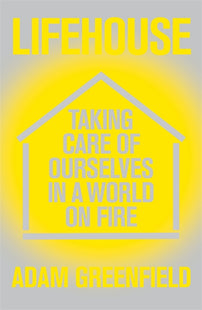
You might not be familiar with the term “Lifehouse.” It’s a chunk of language I introduced in my 2024 Verso book of the same name, to describe autonomous spaces organized as shelters against not merely the immediate, but also the second- and third-order consequences of climate-system collapse — so the heatwaves and droughts and fires and floods, but also the infrastructure and supply-chain disruptions, the crop failures, the physical and psychic unwellness, and the social incapacity that follow on from all of that. Directly inspired by my own experience of Occupy Sandy in New York City in 2012, the book reaches back to a long chain of progenitors, from the Black Panther survival programs to the solidarity clinics of Greece and the neighborhood assemblies of Rojava, to generate a set of tactics we might rely upon to carry us safely through the difficult, dangerous times ahead.
What distinguishes a Lifehouse from the more usual sort of climate-relief initiative is that each is democratically managed by neighbors acting on their own initiative, on the theory that doing so is the best remedy for the overwhelming sense of powerlessness and isolation so many of us feel.
A Lifehouse, then, is not quite the same thing as a resilience hub. If “resilience” is defined as the capacity of some system to restore itself to its previous structure and function following some exogenous shock, a community organized as a Lifehouse refuses this rhetoric entirely. In rejecting the idea of returning to a status quo ante that’s manifestly fucked-up on any number of levels, it leverages whatever shock it’s experienced as an opening toward new possibilities, and more fruitful configurations of power.
And where local resilience hubs are very often entangled with the government in one way or another, a Lifehouse starts from the hard-won recognition that the state cannot help but fail us when the chips are down, even where it’s not outright inimical to our being. Believe whatever you want about the value or utility of the state more broadly, I just don’t think there’s much point in debating whether it can or should furnish the lineaments of a decent and dignified existence for all when it is plain that it does not, anywhere we may happen to live, and is not likely to in any among the sheaf of futures that are available to us.
[book-strip index="1"]
It’s on pragmatic grounds, then, that I believe the most effective strategy available to any of us is to organize the counter-institutions of survival in our own communities. And not just survival for its own sake, but as the Black Panthers framed the matter: as survival-toward-liberation. Wonderfully, I found this sense of things broadly shared at Lifehouses ‘26, which, from its very title on, situated spaces like solidarity kitchens, hacklabs, land trusts and harm-reduction clinics not simply as elements of a mutual-aid or disaster-relief program, but as the very building blocks of dual power.
Key to this was a tight focus on physical space. It seems obvious that refuge from climatic extremes requires physical infrastructure: spaces where unhoused, elderly or otherwise vulnerable people can warm or cool their bodies, when it’s perilous to be outside. Spaces to generate power, and purify water for drinking, and organize care for the sick, injured and depleted. Spaces to warehouse relief supplies in bulk, where enough hot meals for hundreds can be prepared, where mesh-networking gear can be installed so communities can stay in touch with one another when all the other networks are down (or have been interdicted by the state). But antifascist and anti-ICE organizing, too, have physical requirements: spaces where people can gather to plan, prepare, train and recuperate. What the Lifehouse proposes is that these activities can and should occupy the same site, and that this act of co-location works beneficially, as a force multiplier.
The management of physical space, of course, is never straightforward, and nobody understands that better than people who have already experienced the complications for themselves. That’s why it was so refreshing to see Lifehouses ‘26 organized not as a high-theoretical talking shop, but very consciously as “a space for practitioners.” Our time was largely spent in consideration of the concrete questions that go hand-in-hand with living and working together in space: keeping a grip on the ever-turbulent, occasionally fractious psychodynamics of small groups, especially as those dynamics evolve under pressure. Maintaining productive relations with the neighbors, whether those neighbors are curious, indifferent or hostile. Figuring out how to manage disruptive users of the space respectfully, but decisively. Even attending to the pragmatics of rodent control. (Hello cats.)
One other lesson of experience emerged from these conversations, as well, which is that the things a community does to protect itself from a climate turned antagonistic are not so very different from the steps it takes to defend itself against the might of a hostile state. Many of the underlying skills and capacities required are, in fact, identical. The measures taken by activists in the Twin Cities to feed their neighbors at the peak of Operation Metro Surge earlier this year — when thousands literally could not set foot outside for fear of being abducted by masked, armed government agents — were strikingly similar to the ways their counterparts in Vermont helped their towns endure the catastrophic flooding of 2023-2024. The things you do to prepare for one outcome will hold you in good stead when the other comes to pass as well.
It’s one thing when a group of neighbors decides to enact such measures in relative isolation, but quite another for them to build durable connections with the others elsewhere who have arrived at roughly similar conclusions. Past some hard-to-define threshold, a social fabric woven of such connections really begins to shift “dual power” from a pleasant theoretical abstraction to a concrete, functioning reality in the lives of a great many who might not otherwise even think of themselves as being particularly political.
One of the things I was looking for at Woodbine, then, was whether anything like a sufficient commonality of feeling emerged over the course of our conversations to begin moving, however tentatively, toward a continental confederation of Lifehouses.
I can tell you that such a sentiment certainly existed among the practitioners I spoke with at Lifehouses ‘26. It was less plain to me whether the moment for confederation is quite upon us. But what was clear, radiantly so, is that something very like the Lifehouse is one of the signature forms that radical organizing is taking in this moment, and a particularly vibrant and generative form at that. Other than during Sandy itself, or the early days of the Spanish municipalism I witnessed at close range, I simply cannot remember a time I encountered people more energized by their work, more excited, or more justifiably proud of the things they’ve achieved together, in the face of enormous difficulty. The merits of this approach, among those who’ve already adopted it, bear out the old anarchist intuition that the best, and maybe even the only, way in which any of us will achieve anything resembling dignity or justice in this lifetime is to organize it directly and for ourselves, together.
Building the Lifehouse may be the most effective means we have of defending ourselves against the century now unfolding. But what I learned in New York last month is that it’s also how we overwrite the Dread with that curious sense of commingled purpose, power and possibility we know comes to vest in those who commit themselves to organizing in this way. The possibility of achieving some collective articulation of this logic robust enough to keep that Dread at bay feels like a powerful contribution to the politics of our moment. I can’t tell you how much I look forward to seeing what people have made of these first tentative connections by the time the next Lifehouses gathering rolls around in two years' time.
Adam Greenfield has spent the past quarter-century thinking and working at the intersection of technology, design and politics with everyday life. His books include Radical Technologies and Lifehouse. He is host of the Lifepod podcast that looks at many of the issues covered in this post.
[book-strip index="2"]