McKenzie Wark on Occupy Wall Street: 'How to Occupy an Abstraction'

The occupation isn't actually on Wall Street, of course. And while there is actually a street called Wall Street in downtown Manhattan, "Wall Street" is more of a concept, an abstraction. So what the occupation is doing is taking over a little (quasi) public square in the general vicinity of Wall Street in the financial district and turning it into something like an allegory. Against the abstraction of Wall Street, it proposes another, perhaps no less abstract story.

The abstraction that is Wall Street already has a double aspect. On the one hand, Wall Street means a certain kind of power, an oligopoly of financial institutions which extract a rent from the rest of us and in exchange for which we don't seem to get very much. "What's good for General Motors is good for America" was the slogan of the old military industrial complex. These days the slogan of the rentier class is: "What's good for Goldman Sachs is none of your fucking business."

This rentier class is an oligopoly that makes French aristocrats of the 18th century look like serious, well organized administrators. If the rhetoric of their political mouthpieces is to be believed, this rentier class are such hot house flowers that they won't get out of bed in the morning for less than a thousand dollars a day, and their constitutions are so sensitive that if anyone says anything bad about them they will take their money and sulk in the corner. They have, to cap it all, so mismanaged their own affairs that vast tracts of public money were required to keep them in business.

The abstraction that is Wall Street also stands for something else, for an inhuman kind of power, which one can imagine running beneath one's feet throughout the financial district. Let's call this power the vectoral. It's the combination of fiber optic cables and massive amounts of computer power. Some vast proportion of the money in circulation around the planet is being automatically traded even as you read this. Engineers are now seriously thinking about trading at the speed of light. Wall Street in this abstract sense means our new robot overlords, only they didn't come from outer space.

How can you occupy an abstraction? Perhaps only with another abstraction. Occupy Wall Street took over a more or less public park nestled in the downtown landscape of tower blocks, not too far from the old World Trade Center site, and set up camp. It is an occupation which, almost uniquely, does not have demands. It has at its core a suggestion: what if people came together and found a way to structure a conversation which might come up with a better way to run the world? Could they do any worse than the way it is run by the combined efforts of Wall Street as rentier class and Wall Street as computerized vectors trading intangible assets?

Some commentators have seen the modesty of this request as a weakness of Occupy Wall Street. They want a list of demands, and they are not shy about proposing some. But perhaps the best thing about Occupy Wall Street is its reluctance to make demands. What's left of pseudo-politics in the United States is full of demands. To reduce the debt, to cut taxes, to abolish regulations. Nobody even bothers with much justification for these any more. It is just sort of assumed that only what matters to the rentier class matters at all.

Its not that the rentier class buys politicians in America. Why bother when you can rent them by the hour? In this context, the most interesting thing about Occupy Wall Street is its suggestion that the main thing that's lacking is not demands, but process. What is lacking is politics itself. 

It may sound counter-intuitive, but there really is no politics in the United States. There is exploitation, oppression, inequality, violence, there are rumors that there might still be a state. But there is no politics. There is only the semblance of politics. Its mostly just professionals renting influence to favor their interests. The state is no longer even capable of negotiating the common interests of its ruling class.

Politics from below is also simulated. The Tea Party is really just a great marketing campaign. It's a way of making the old rentier class demands seem at least temporarily appealing. Like fast food, it will seem delicious until the indigestion starts. It's the Contract on America, its Compassionate Conservatism, but with new ingredients! The Tea Party was quite successful. But you can't fool all of the people all of the time, and no doubt there's a new marketing campaign waiting in the wings for when it runs out of steam. But none of this is anything but the semblance of a politics.

So the genius of the occupation is simply to suggest that there could be a politics, one in which people meet and propose and negotiate. This suggestion points to the great absence at the center of American life: a whole nation, even an empire, with no politics.

Wall Street is a name for an abstraction with the double sense of a rentier class which uses vectoral power to control resources that bypasses political processes which at least had to negotiate with popular interests. Against this, the occupation proposes another abstraction, and it too has a double aspect. 

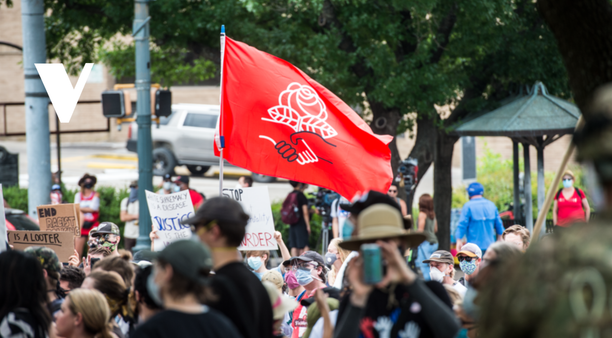
On the one hand, it's a physical thing, a taking of space. This has confused the New York Police Department, which has responded with clumsy tactics. It just can't figure out what to do with an ongoing occupation that is peaceful and mostly content to camp out, but which swells on the weekends to thousands of people. There's a danger that it could become about the NYPD and its cack-handed arrests and either devious or incompetent crowd management.

It is possible that Occupy Wall Street has the rentier class a bit spooked. Not that they would be too bothered by a few anarchists, but they are bothered by the very possibility of any cascading of events that could really catch fire from this largely symbolic action. In the absence of any real competence at the growth and refinement of a political economy, the rentier class has basically decided to loot and pillage from what is left of the United States and to hell with the consequences. They just don't want to be caught doing it.

The taking of a tiny square in downtown New York hardly impinges on the power of the vector. It doesn't even inconvenience the minions who work in the surrounding offices, but the actual occupation is connected to a more abstract kind of occupation, and the slightest hint that it could spread disturbs the fragile constitutions of the rentier sensibility.

The occupation extends out into the intangible world of the vector, but not in the same way as Wall Street. The cop who was stupid enough to pepper-spray some women who were already cordoned off behind orange mesh was quickly identified by hackers, and all his information appeared on the internet for all to see. The incident on the Brooklyn bridge where the police let people onto the roadway and then arrested them for being on the roadway is on the internet from multiple angles. The occupation is also an occupation of the social media vector.

The so-called mainstream media doesn't quite know how to deal with this. The formalities of how 'news' is now made is so baroque that news outlets descended to weird debates about whether the occupation is 'news.' It doesn't have top tier publicists. It didn't issue free samples. It doesn't buy advertising space. It started without any celebrity spokesmodels. So how can it be news? The occupation exposed the poverty of reporting in America. And that in itself is news. 

The abstraction that is the occupation is then a double one, an occupation of a place, somewhere near the actual Wall Street; and the occupation of the social media vector, with slogans, images, videos, stories. "Keep on forwarding!" might not be a bad slogan for it. Not to mention keep on creating the actual language for a politics in the space of social media. The companies that own those social media vectors will still collect a rent from all we say and do - not much can be done about that - but at least the space can be occupied by something other than cute cat pictures.

While intellectuals have gotten into the habit of talking about The Political, the occupation has proceeded by creating a lower-case-politics which is abstract and yet at the same time completely everyday. Its no accident that it started with what we might broadly define as 'anarchists', who have been working on both the theory and the practice for some time now.

The organized labor movement started paying attention when it looked like the anarchists and the following they drew would not be easily dissuaded by bad weather or the NYPD. It is as if organized labor woke up one morning, saw that the occupation was still going strong, and said to itself "I must follow them, for I am its leader!" It beats trying to steal members from already unionized workplaces, which seems to be mostly what the unions do.

By now what we have here is what I would call a weird global media event. It is an event in that nobody knows what will happen next. It is a media event in that it's fate is tied to the occupation of the double space of Zucotti square and the media at the same time. It is a global media event at least since the NYPD arrested people on the Brooklyn Bridge and handed the occupation great free publicity. (Thanks guys!) And it is a weird global media event in that it has unprecedented elements that set it outside the staple stories of now boredom, dissent, utopia and all that other stuff is usually managed and assuaged. 

For example, commentators tie themselves in knots over whether it is a social movement or not. It is an occupation. It is in the title in case you missed it: Occupy Wall Street. Those who have been paying attention will notice it is part of a global wave of anarchist inspired occupations, big and small. My own university, the New School for Social Research, was occupied in 2008, however briefly. This is a tactic that has been tried and refined for a few years now.

An occupation is conceptually the opposite of a movement. A movement aimed for some internal consistency within itself but uses space just as a place to park its ranks. An occupation has no internal consistency in its ranks but chooses meaningful spaces which have significant resonance into the abstract terrain of symbolic geography.

That it just doesn't do some of the things social movements do is part of why its working, at least so far. It is as remote from The Political as some intellectuals would have it, but it is also different to the Social Forum politics of the recent past as well. For those who want a theory to go with the practice, you will have to look elsewhere than to Negri or Badizek (Badiou+Zizek). There's no multitude; there's no vanguard.

If the occupation is a little confusing for us intellectuals, take pity on our poor billionaire mayor! Bloomberg suggested that the occupation was inconveniencing regular banker struggling on a mere 40k-50k per year. The average household income in my neighborhood, which is quite a nice one, is just under 40k per year - and that's household income. The "poor bankers!" line seems unlikely to garner much sympathy.

So as to how this plays out, nobody knows. That's how it is with weird global media events. It's a test of wills. The NYPD are not quite ready to use strong force in case that's counter-productive. There could be quite a few people - anarchists or not - willing to get arrested. There could be quite a reservoir of popular support. For once the object of the occupation is something generally held in low regard by just about everybody who doesn't benefit from it. The key is keeping the focus on the abstraction that is Wall Street, the pernicious effects of which pretty much everyone feels in their daily life.  

More in #Articles#Occupy

21 comments

It occurred to me after I wrote this that there's another side to the arrests on the Brooklyn Bridge. Whatever other motives might have been involved, I'm guess that arresting 700 people creates a great data sample set for police intelligence. I'm sure they were very curious to know what kinds of people showed up: from which boroughs, with what kinds of jobs, etc. They would now have the best information on this. While most attention has been on a certain pepper-spray-wielding police officer, there's another, more modern side to the NYPD. Since Bratton it became more "data driven". The police know the power of abstractions also.
Mc Kenzie Wark / 03 October 2011 2 people think so
So many shimmering sentences!  So simply and transparently set upon the thing! Thank you so very FAWKING much!
Rich Jensen / 03 October 2011 1 person thinks so
Whether you are being ironic or not, Rich, you're fawking welcome.
Mc Kenzie Wark / 03 October 2011
I call upon my euro-cultural nochalance, saying; first as tragedy then as farce: One of the few radical movements, whom more or less never moved anything else but their own limits of aesthetic egocentrism - dancing around in 'fawrrests' - is the only thing I recall about the situationists. Nonetheless, discipline and fidelity wasn't exactly their kind of thing. So you think the silent screams of New-Age-Guy-Fawkes revolutionaries, possess great potential of shaking the grounds of the Symbolic order? Or is it divine rage manifesting itself through silent screams? -The Real of capitalist speculative investments might be more or less pure abstractions, yet wherein consists the Acting proper, giving ground for re-Symbolization'? - Total passivity or some contigent act of impotent though necessary violence?

But nice equilibrism anyway, I had a good laugh. 
D. Joe / 03 October 2011 1 person thinks so
Ha!  Not ironic at all. (I can't manage irony, comes out all ruined.)  No, straight-up, dozens of great sentences.  Pithy and vernacular: just my speed.  And addressing drifts and echoes similar to those engaging me since the occupation began.

Fascinated by the twinning of discourse to space. The kids' bodies in the park are public meaning-sparkers just being there.

Remember that famous quote from the early Bush II-era? It was attributed to Rove. Something like: "We will act. And you will tell our story. And we will act again." 

I feel like "the 99%" are finally in the game. And look! It's a hot-streak!

Take care. You sold another book!  

See you around the beach,  

R
Rich Jensen / 03 October 2011 1 person thinks so
As the Situationists used to say, "our ideas are on everybody's minds." That turns out to be the case also with the occupation, which is now spreading elsewhere. 

The best one can do is negative action, which reveals the gap between what one can do and what needs to be done. That gap is where critical thought finds its energy. 


Mc Kenzie Wark / 03 October 2011 2 people think so
Ha!  No, I can't manage irony.  Straight up, many great sentences.  Pithy and populist, just my speed.

Congratulations, you sold a book! 

See you down the beach,

Rich Jensen / 03 October 2011 1 person thinks so
Thanks Rich, you write spritely yourself!
Mc Kenzie Wark / 03 October 2011
Great read.  I think your piece raises some interesting questions about symbolic geography. For instance, what happens to #occupyla if #occupywallstreet disappears for whatever reason (mass arrests, a storm or tornado, twitter 'goes down' etc)? This raises two more questions. First, if the physical space is important then how should we reformulate the idea of the public square and what are the consequences?  I ask because at last night's general assembly in LA, there was a proposed action to #OccupyRodeo on October 15.  The argument was made that Rodeo Drive is a much more important public space to swarm because "no one is here [referring to city hall] on the weekends."  Here then, we have the problem of desiring space, but not just any space, but spaces that create dialogue and conversation, or to occupy spaces with consequences.

Secondly, how has social media acted as a vector with the capacity or organize and create affinities among occupations and/or occupiers?  This vector has been consequential for the process of formatting other groups and shaping the idea of the 99% globally. Like the internet, the occupations arise in nodes and reflect the politics of inclusion and sharing (I mean, just look at all the free pizza).  However, the way that the localized problems of inclusion get addressed between the physical space of the occupation and the social media vector needs drastic attention. The presentation of #occupyla online has overwritten the dissent that has appeared, reappeared, and then disappeared during general assembly. The chants last night of "bye-bye-bye" to one fellow occupier who was accusing some of handing the names of people on the contentious "end police brutality committee" over to the police has serious consequences for 'team spirit' as well as the network of trust that we hope to build.  But again, is it trust or the appearance of trust that we desire?  We set out on twitter to "follow" one another, but we must remember as the Zapatistas have shown us that when moving we must not follow, but rather ask questions as we walk at a pace suitable for all.
Boston Joan / 05 October 2011 1 person thinks so
Immensely enjoyed your book on the SI, but between some of the comments in the introduction and from the piece posted above, I can't help but notice your slight disdain for the "High Theory" of Badiou, Zizek ("Badizek") and others. It's not as if the "low theory" of Jorn and Debord is easier to grapple with at times, even with your approachable and engaging interpretation and style. 
Gabe Jones / 05 October 2011 1 person thinks so
@Boston Joan: I agree that "the way that the localized problems of inclusion get addressed between the physical space of the occupation and the social media vector needs drastic attention." 

Its also an interesting question as to what kinds of spaces have symbolic meaning in particular places. Wall st has global resonance. What would one occupy in Buffalo or Cleveland? There's still centers and peripheries to that abstract space.
Mc Kenzie Wark / 05 October 2011
@Gabe Jones: The disdain for Badizek is partly for rhetorical effect. Its about bringing another perspective to the fore with equal claims to be extensions of critical theory into the present. Low theory is still theory and hence a bit of a challenge, but i hope more fun to live with day to day.
Mc Kenzie Wark / 05 October 2011
Ken, what you write here about Wall Street is amazing - so transparent, all the ideas are right there in the Occupation itself - but need to be put into words, and you did.  thanks, C.
Chris Kraus / 06 October 2011 1 person thinks so
Thanks, Chris. But yes, i'm just reporting the occupation's own ideas, at least as i see them.
Mc Kenzie Wark / 06 October 2011
 It is as if organized labor woke up one morning, saw that the occupation was still going strong, and said to itself “I must follow them, for I am its leader!” It beats trying to steal members from already unionized workplaces, which seems to be mostly what the unions do.

Cheap shot, Ken. Are you a member of your faculty union? Unions negotiate contracts. And they still do. Being confined to business unionism has been one of the tactics of capital ,of course. The result of the postwar Historic Compromise was to produce compliant top leaders too comfortable with power, but there are many other reasons why the union movement, including insurgent rank and file attempts, is in the process of being squeezed to death. (Hint: outsourcing, neoliberalism, bankster-owned politicians, right-wing populism.) But organizing the working-class unorganized, as in the Justice for Janitors movement of the end 20th century, NY's TWU, the taxi driver's alliance, and other efforts deserve more than your scorn. 
 
Martha Rosler / 16 October 2011
What they deserve is more support from other unions. 
Mc Kenzie Wark / 16 October 2011
Interesting view on the symbolism of an occupation. I would add another dynamic if I may. The term occupation is also very compelling in its anonymity. The ideas perpetuated by those at zuccoti park, similar to militants blending in to a civilian populace, go out into the world and infilitrate common discussion. If the majority of Americans, particularly those making $50,000-100,000, are willing to say yes that hippy banging on his drum influences my discussion and ideas that is terrifying to the rentier class. Already we have seen Cantor cautiously stepping away from his "mob" remarks. An occupation of not only the Political discussion on the national stage but the dinner table discussion of the tea party members. The little girl asking her father why are those young people walking in the street and why are they so angry. The father struggling to lie through his teeth that they are there because they are lazy, and that things will be different when she grows up. Its an infusion of ideas that cannot be removed. How do you explain America's democratic freedoms and indoctrinate strict constitutionalism, but demonize the occupiers demonstration of free speech. While I see it highly unlikely the protesters will change the ideology of those of the far right, it will influence those they try to indoctrinate in the future simply by being present.
Jared Coomes / 18 October 2011 1 person thinks so
Interesting view on the symbolism of an occupation. I would add another dynamic if I may. The term occupation is also very compelling in its anonymity. The ideas perpetuated by those at zuccoti park, similar to militants blending in to a civilian populace, go out into the world and infilitrate common discussion. If the majority of Americans, particularly those making $50,000-100,000, are willing to say yes that hippy banging on his drum influences my discussion and ideas that is terrifying to the rentier class. Already we have seen Cantor cautiously stepping away from his "mob" remarks. An occupation of not only the Political discussion on the national stage but the dinner table discussion of the tea party members. The little girl asking her father why are those young people walking in the street and why are they so angry. The father struggling to lie through his teeth that they are there because they are lazy, and that things will be different when she grows up. Its an infusion of ideas that cannot be removed. How do you explain America's democratic freedoms and indoctrinate strict constitutionalism, but demonize the occupiers demonstration of free speech. While I see it highly unlikely the protesters will change the ideology of those of the far right, it will influence those they try to indoctrinate in the future simply by being present.
Jared Coomes / 18 October 2011
I don't know that far right ideology is actually all that appealing to all that many Americans. It gets media time out of all proportion to its actual base of support. That's why the broad populist appeal of OWS is proving effective. To the extent that people actually hear about it, it chimes with a lot of people's experience. Ironically, the 'astroturf' populism of the Tea Party might have even paved a way in popular discourse for OWS. The anger the Tea Party tapped into was genuine, but it could hardly offer much to that anger given its financial backing from the rentier class itself. 

In sum, i completely agree with your concluding remark: "While I see it highly unlikely the protesters will change the ideology of those of the far right, it will influence those they try to indoctrinate in the future simply by being present."
Mc Kenzie Wark / 18 October 2011
Excellent elaboration on this Hipster-Fascist movement.  I of course agree with your points regarding its lack of internally-consistent goals or demands, its focus on 'taking space' (action/seizure), a (quasi-mystical?) belief in 'symbolic geography', being organized around hatred of abstractified enemies, and the related characteristically-fascist traits of this movement.  What I had not noticed or at least been able to put into words quite so well was the 'double' vector of this movement - the one you aptly analogize to the tactics of forwarded-email-jokes or spam ("Just keep forwarding!"), so I am in your debt for that observation.  Please continue to delve into and expound upon Hipster Fascism for us.
Sonic Charmer / 09 November 2011
You're welcome. Like any such event, the occupation is a heterogeneous thing. If you want to see neo-fascism, however, i would suggest looking at the Tea Party. If you want to see hipsters, just walk down Bedford avenue. (They still walk down it as if nothing else was happening). If you want to see hipsters and fascists duke it out, just check the #ows hashtag on twitter. 
Mc Kenzie Wark / 09 November 2011

Add a comment

Response Form