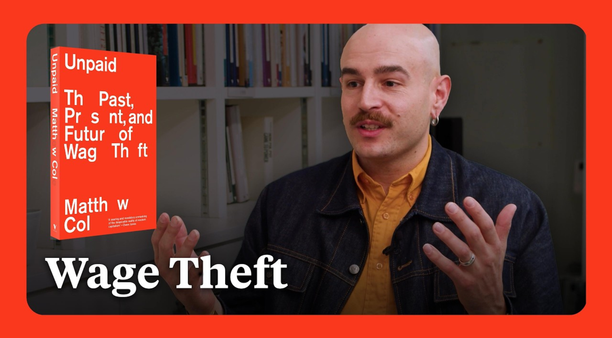
In her newest book Raising Expectations (and Raising Hell), author and maverick organizer Jane McAlevey draws on her two decade-long experience and sets out a plan for revitalizing labor. Reacting to Michigan’s Republican-dominated legislature’s passage of the so-called “right to work” law (an uncomfortable term to use due to its racist origin) and the corporate-backed effort to push for similar legislation nationwide, she made several big media appearances last week and over the weekend to outline the state of labor in America (prognosis: not good) and how labor can be revived. She appeared on MSNBC's UP with Chris Hayes, Counterspin, KALW in San Francisco, The Real News, Huffpost Live, and KBOO community radio in Portland. Audio lies below the jump. Click on the links to listen and watch the interviews in full.
That race is a mere social construct is an oft-repeated assertion in the media and academia. That there is no currency to the color of someone’s skin, but there is for the content of his or her character has become the mantra of this supposedly post-racial era. Then why does the concept of race still poison our discourse? And in a time of rapidly growing income inequality, how does race cloak the much-needed issue of tackling this problem for all Americans, regardless of race?
In their fantastically lucid and much-needed exposé of the mental terrain that underlies the issue of race, Racecraft: The Soul of Inequality in American Life, Karen and Barbara Fields deal with how it obscures gross income inequality. They coin the term “racecraft”—the illusion of race produced by the practice of racism.
Karen Fields discussed these and other topics concerning the practice of racecraft in two illuminating interviews, respectively for the New Books in Sociology podcast and The Academic and the Artist on KBeach radio.
Audio below the jump
Back in 1954, union membership stood at almost 35 percent of the workforce. This was an era where high economic growth was paired with livable wages. But the story has since changed, as union membership in the private sector now stands at less than 7 percent.
The story of unionism in America has been marked by its current moribund state. Years of successful union busting by Reagan-inspired corporate thugs, starting with the Gipper’s presidency right up to the current occupant of the White House have sapped the will of the labor movement in the United States.
But within all that there were a few people who fought to buck that trend—oftentimes successfully. One of them was Jane McAlevey. In this engrossing excerpt published in AlterNet from her tremendous tell-all account of her years as a maverick labor activist, Raising Expectations (and Raising Hell): My Decade Fighting for the Labor Movement, McAlevey recounts her successful battle against a Universal Health Services-owned for profit hospital in Las Vegas to stop the decertification of a hospital workers' union. Where do you start when organizing an entire industrial sector according to McAlevey? Not with the weak, underperforming shops where workers are most likely to be underpaid and angry:
No, you start with the high-performing, income-generating outfits. You assume you are going to win the organizing drive (this leaves out the vast majority of union organizing), and when you do, you want to end up sitting across the table from an employer who actually has some money to pay for a good contract. Now, this presumes you care about winning a high quality contract (even more unions fall out of the mix). But you care about this, because you want the workers at all the hospitals in the market to see what is possible to win with a union.
Visit AlterNet to read the excerpt in full.
Raising Expectations will be published on November 20th.
Has the Nobel Peace Prize Committee jumped the shark? In what seemed an early April Fool’s prank, the Committee awarded the Nobel Peace Prize to the European Union for, in the words of chairman Thorbjoern Jagland, its historic role in transforming Europe "from a continent of wars to a continent of peace." This honor was bestowed despite the EU’s savage push for immiserizing austerity on Spain, Italy, and Greece—cuts that have led to violence on the streets, and the participation of many of its member states NATO military interventions in Afghanistan and Libya.
Today, on Democracy Now!, Tariq Ali, author of many books including The Obama Syndrome: Surrender at Home, War Abroad, discussed his reaction to the Committee’s decision, stating:
To give the prize to the European community, at a time, effectively, when economically, it is promoting unemployment, creating real class divides in virtually every country in Europe, where it has led to enormous violence on the streets of Greece, because of the policies being pushed by the EU ... it is a complete and utter joke.
Visit Democracy Now! to watch the interview in full.