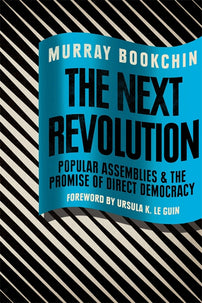
Bookchin, Murray
BOOKCHIN, MURRAY (1921-2006). One of the foremost contemporary libertarian socialist theorists, Murray Bookchin was born in New York of Russian Jewish immigrant parents. He entered the Communist movement at age nine and became a militant, first in the Young Pioneers, and later in the Young Communist League (YCL). He broke with Stalinism in the late 1930s, was expelled from the YCL, and entered the Trotskyist movement, joining the Socialist Workers’ Party. In the early 1940s he worked in an iron foundry and organized for the United Electrical workers. After several years in the US Army in the mid-1940s, he began working in an auto plant, where he became an organizer for the United Auto Workers.
By the 1950s, Bookchin had abandoned Trotskyism in favor of libertarian Marxism and wrote extensively for the libertarian Marxist journal Contemporary Issue. It was there that he published his pioneering 1952 essay “The Problem of Poisons in Food,” in addition to other environmentally-focused articles. In 1963, he published Our Synthetic Environment, an early critique of the developing environmental crisis that was particularly well received in Europe and contributed to the nascent American environmental movement.
During the 1960s, Bookchin emerged as a central figure in contemporary American anarchism and as the major influence on the development of a strong eco-anarchist current within that movement. He was a force in various anarchist organizations, including the Radical Decentralist Project, the third largest faction of Students for a Democratic Society. As both a theorist and an indefatigable speaker, he exerted a major influence on the revival of anarchism as both a cultural tendency and a political movement.
Beginning in the early 1970s, Bookchin began to make major advances in his theoretical and practical development of social ecology. In 1974 he co-founded the Institute for Social Ecology at Goddard College in Vermont. From 1974 to 1983, he was also a professor of social theory at Ramapo College in New Jersey. In a little over a decade he published a series of significant works in ecological social theory, including Post-Scarcity Anarchism (1971), The Limits of the City (1974), Toward an Ecological Society (1980), and his magnum opus, The Ecology of Freedom (1982). The latter work, considered a classic of the anarchist and left libertarian tradition, is a sweeping interpretation of world history, in which he depicts the decline of egalitarian “organic societies” and the rise of social hierarchy, followed by an epochal struggle between forms of domination and emerging forms of freedom.
At the same time Bookchin had a growing reputation as an urbanist, as a result of his book on the city and widely read articles such as “The Myth of City Planning” (1973). His subsequent 1986 work, The Rise of Urbanization and the Decline of Citizenship (later republished as Urbanization Without Cities and From Urbanization to Cities) definitively established his place in radical urbanism. In this book, which was an important contribution to the history and social ecology of cities, Bookchin advanced the critique of the megalopolis and developed his theory of libertarian municipalism as the politics of social ecology.
In Remaking Society (1989) Bookchin sought to make his ideas more accessible by summarizing his theoretical position and his interpretation of history, and by further elaborating on libertarian municipalism as a program and movement that might constitute a revolutionary challenge to the dominant system. He argued for the development of movements for municipal power, for the establishment of direct democracy at the local level, expressed especially in the form of neighborhood and municipal assembles, and for the emergence of confederations of liberated municipalities.
During the 1980s, Bookchin became an important figure in the Green Movement in both the United States and Germany. In the United States, he had significant influence within the Green Committees of Correspondence and the Green Party USA and was a major inspiration for the Left Green Network and the Youth Greens. When the Green Party of the United States eclipsed the more radical GPUSA, Bookchin’s influence dwindled. He ultimately broke with the American Greens over their reformist tendencies and growing obsession with conventional electoral politics. During this period, Bookchin also had a considerable following, and some close ties, among the fundamentalist or “fundi” faction in the German Green Party and was especially close to the Radical Ecology Group. His influence on the German movement also faded with the triumph of the more centrist or “realo” faction in the early 1990s. By this point, Bookchin no longer saw the global Green Movement as a promising arena for radical social ecological politics. Rather, he envisioned a future in which a libertarian municipalist political movement would become the agent of the revolutionary social transformation that the Greens had failed to undertake seriously.
Bookchin’s municipalism gained appeal. He presents a vision in which agency reemerges as the atomized masses of late capitalism are transformed into a body of active citizens, and the citizens of the municipality develop into “the People.” Further, he attributes a pivotal role in social transformation to a developing radical intelligentsia that will propagate the ideology of libertarian municipalism, social ecology, and dialectical naturalism.
Thus, Bookchin presented a potentially compelling image, at the personal level, of the engaged, ethically-responsible citizen, and, at the social level, of the municipality and large federations of municipalities as the locus of a dual power that could challenge the power of capitalism and the state. To some, this signaled the recovery of the lost, yet still necessary, concept of the historically viable revolutionary subject.
By the 1990s, Bookchin was increasingly presenting himself as a defender of Enlightenment values against what he saw as a rising tide of post-modern relativism, nihilism, and socially irresponsible individualism that had devastating consequences for the left. He bemoaned the growing popularity of Asian philosophies, Daoism in particular, which he considered to be quietistic, irrational, and productive of a “passive-receptive” mentality. He carried on a lengthy campaign against deep ecology as being dangerously anti-human, irrational, and having fascist undertones, and he dismissed post-structuralist philosophy as destructive of reason and truth. While in his earlier work he stressed the liberatory and ecological sensibilities and values of indigenous cultures, he became more critical of these traditions and of what he saw as a tendency to romanticize them. He also became a vehement opponent of neo-primitivist and anti-civilizational tendencies within anarchism. Bookchin outlined his critique of his various adversaries in his book Re-enchanting Humanity: A Defense of the Human Spirit Against Anti-humanism, Misanthropy, Mysticism, and Primitivism (1996).
By the mid-1990s Bookchin had become a harsh critic of contemporary American anarchism. In Social Anarchism or Lifestyle Anarchism: An Unbridgeable Chasm (1995) he claimed that the legacy of social anarchism had been betrayed by contemporary anarchism, which had become predominantly a form of personal rebellion. He sometimes went even further in his criticism, claiming that not only contemporary anarchism, but much of the historical anarchist tradition was fundamentally individualist in nature. In 2002, he explicitly broke with anarchism, and from this point distinguished sharply between what he called “anarchism” and his own politics, which he labeled “Communalism.”
In The Philosophy of Social Ecology: Essays on Dialectical Naturalism (1990), Bookchin presented in some detail his general philosophical position, which he called “dialectical naturalism,” and described as the result of a process of “ecologizing the dialectic.” He departed from the tradition of radical dialectic, with its focus on non-identity and contradiction, and presented a concept of dialectic that focused on the unfolding of a being’s potentiality as it moves toward full actualization. Bookchin was unusual in looking to Aristotle (along with Hegel, in that thinker’s most Aristotelian moments) as the paradigm for dialectical thinking. Like Aristotle, he associated dialectic with the unfolding of the immanent teleology within a being, though he rejected the term “teleology,” which he thought implied a necessary development. Another key aspect of Bookchin’s thought is his contention that the idea or “notion” of the domination of nature arises out of the real domination of humans by other humans, a view that is generally considered by his followers to be a crucial and distinctive insight. While Bookchin’s dialectical naturalism has received little notice in philosophy, his social ecology, especially in connection with his debates with deep ecology and other political ecologies, has received some attention in the field of environmental ethics.
Bookchin’s last major intellectual project was The Third Revolution, a four-volume, 1500-page work on European revolutionary movements from the peasant revolts of the Late Middle Ages through the defeat of the Spanish Revolution. In this work, he presents a political and ethical interpretation of modern revolutionary movements that challenges what he sees as the economic and technological reductionism of Marxist and other more academically mainstream perspectives and stresses the authenticity and historical efficacy of revolutionary ideas and ideals. The first volume of this expansive work begins with the peasant revolts and focuses on the English and French revolutions, the second analyses nineteenth-century revolutions, including the Paris Commune, the third concentrates on the Russian Revolutions of 1905 and 1917, and the series concludes with an analysis of the Spanish Revolution, the last of the great classic European revolutions. Since the period in which classical anarchist theorists such as Reclus, Bakunin and Kropotkin undertook extensive analysis of revolutions, there have been few major anarchist or libertarian socialist assessments of the history of revolution, and none on the scale of Bookchin’s impressive project.
Another undertaking that Bookchin long considered important, yet never completed, is The Politics of Cosmology. This unfinished work was left behind as a thousand-page unpublished manuscript. It does not literally address cosmology, but is, rather, a critical survey of the history of philosophy from Bookchin’s dialectical naturalist perspective. The undertaking is very impressive in scope but ignores decades of intense theoretical debate and major reinterpretations of figures such as Spinoza, Hegel, and Marx who are central to his arguments. Nevertheless, the work is useful for understanding the background of Bookchin’s philosophical musings in The Philosophy of Social Ecology and other works.
Interest in Bookchin’s work waned in his later years and after his death, but saw a significant revival as the result of his influence on the thought of Abdullah Öcalan, leader of the Turkish revolutionary movement, the PKK, and the major inspiration for the revolution in Rojava in Northern Syria. The influence of Bookchin on Öcalan’s thought can be seen in the latter’s emphasis on domination rather than class in what he calls history’s “central civilization,” and his adoption of concepts of first, second, and third nature similar to those of Bookchin. Of more historical importance are the strong commonalities (though not without important differences) between Öcalan’s democratic confederalism and Bookchin’s libertarian municipalism on topics such as local assemblies, direct democracy, decentralization of power, non-hierarchical confederation, and the ecological dimensions of politics.
One of Bookchin’s lasting achievements was to act as the conduit by means of which the great libertarian revolutionary tradition was transmitted to an important contemporary revolutionary movement with wider global resonances. There is a certain irony, and one might even say a “cunning of reason,” in the fact that despite Bookchin’s almost exclusive focus on European radical traditions, he helped these libertarian ideas take root in southwest Asia, the “Cradle” of both Civilization and Domination.
Further reading
Biehl, Janet, ed. The Murray Bookchin Reader. Montreal: Black Rose Books, 1999.
Watson, David. Beyond Bookchin: Preface for a Future Social Ecology. Brooklyn: Autonomedia and Detroit: Black and Red, 1996.
White, Damian F., Bookchin: A Critical Appraisal. London: Pluto Press, 2008.
Murray Bookchin. Anarchy Archives. An Online Research Century on the History and Theory of Anarchism. http://dwardmac.pitzer.edu/Anarchist_Archives/bookchin/Bookchinarchive.html
Murray Bookchin Papers, 1950-2003. Preliminary Inventory. Tamiment Library and Robert F. Wagner Labor Archives, New York University. http://dlib.nyu.edu/findingaids/html/tamwag/tam_160/
Book strip #1
Book strip #2
-
 A Lifehouse is an institution at the heart of each neighborhood that responds to the terrifying reality of climate collapse in our own communities.In this book Adam Greenfield, author of Radical Te...
