Pan-African Movement
PAN-AFRICAN MOVEMENT. After the Russian Revolution, the Pan-African movement was the most important political influence in constituting a global Left in the twentieth century. Between its founding in London in 1900 and its organizational apex, the 1945 Pan-African Congress in Manchester, England, Pan-Africanism attracted leading Marxists from the colonized world and laid the political, ideological, and tactical groundwork for the successful liberation of Africa and Asia. Pan-Africanism’s role in the creation of a US Left developed in two stages: the 1920s, after the Second and Third Pan-African Congresses; and after World War II, when a generation of Black radicals began to align African American freedom struggles with Pan-African decolonization.
The first Pan-African Conference was organized in London by Trinidadian barrister Henry Sylvester Williams and was attended by a small group of educated leaders in the African diaspora, including W.E.B. Du Bois. Though liberal and reformist in vision, the Congress was the first unified response by people of African descent to the 1885 partition of Africa by the European powers. It sought to “secure to Africans throughout the world true civil and political rights.” Its founding “Message to the World” included W.E.B. Du Bois’s articulation of a global “color line” that would frame anti-racist and anti-colonial struggles across the twentieth century.
In 1919, with financial support from the National Association for the Advancement of Colored People (NAACP), a second congress was held in Paris. American attendees included Du Bois; John Hope, President of Morehouse College; Joel Spingarn, a white member of the NAACP; Rayford Logan, later to become a prominent Black journalist; and Black women’s rights activist Ida Gibbs Hunt. The 1919 Congress was a response to the Treaty of Versailles meetings in Paris. Delegates adopted a resolution calling for “the international protection of the natives of Africa” and direct League of Nations supervision of the colonies. It also called for the abolition of slavery and exploitation in the colonies. While these demands were not met, the Congress began to tie African American domestic civil rights struggle to war, imperialism and colonialism.
The third Pan-African Congress in 1921 reflected the influence of both the Bolshevik revolution of 1917 and the Communist International’s commitment to “self-determination” struggles of oppressed colonial subjects. Its “Declaration to the World” demanded the “establishment of political institutions among suppressed peoples” and called for “self-government for the Africans in Africa.”
The third Pan-African Congress was influential on the emerging African American Left. Its anticolonial vision attracted more Afro-Caribbean intellectuals to Pan-Africa’s orbit and gave momentum to the participation of hundreds of African Americans at the fourth Congress held in New York City in 1927. That congress was financed heavily by the Women’s International League for Peace and Freedom, an antiwar organization. More than 200 delegates from twenty-two states and the District of Columbia were present. The Congress passed a resolution demanding Black political rights, and another arguing for African self-determination “not merely for the profit of Europeans.” The Congress also drew further attention to the Pan-African Black nationalism of Marcus Garvey’s Universal Negro Improvement Association, while exacerbating divisions between Garvey and Du Bois and other Pan-African Congress leaders. Du Bois himself called Garvey’s repatriation plans for Black Americans to Africa “impossible.”
The next Pan-African Congress was held in 1945 in Manchester, England. Though few African Americans attended (Du Bois was one of them) the Congress jumpstarted the decolonization movement. At Manchester, African farmers, workers and trade unionists took center stage. Anti-imperialist resolutions condemned the “systematic exploitation of the economic resources of the West Africa territories.” The Congress’s most important statement, “Declaration to the Colonial Workers, Farmers and Intellectuals,” written by Kwame Nkrumah, called for strikes and boycotts and ended with a revision of the closing sentence of the Communist Manifesto: “Colonial and Subject Peoples of the World---Unite!” After Manchester, Nkrumah returned to Ghana to form the Convention People’s Party that led Ghana to independence in 1957.
The wave of decolonization of African and Asian countries after 1945 drew African American radicals and intellectuals into closer contact with the Pan-African Movement. The novelist Richard Wright traveled from Paris to attend the 1955 Bandung Conference in Indonesia, where leaders from twenty-nine decolonizing Africana and Asian countries met to unify anticolonial struggles. Wright then traveled to Ghana and wrote the book Black Power in support of Nkrumah’s ascendant Convention People’s Party. In 1956, novelist James Baldwin attended the first Congress of Black Writers and Artists organized by the Pan-African literary quarterly Presence Africaine. Baldwin reported on the Congress theme of “Negritude,” proposed as a unifying theme for Black identity and cultural production in the diaspora. Baldwin’s article on the event, “Prince and Powers,” was published in the literary journal Preuves, unbeknownst to him a front for the CIA’s Congress for Cultural Freedom. The essay introduced many African Americans to both Pan-Africanism and the Negritude theme. Negritude ideology subsequently influenced the US-based Black Arts Movement.
In 1958, one year after Ghanaian independence, Nkrumah along with Sekou Toure of Guinea and Gama Abdel Nasser of Egypt, also recently decolonized, attended a meeting in Harlem. It was their first encounter with Malcolm X, then a young preacher for the Nation of Islam. One year later, Malcolm visited Egypt and Africa for the first time. The trip was followed by visits to Beirut, Nigeria, Morocco and again to Mecca in 1964. In June, 1964, Malcolm announced the founding of the Organization of African-American Unity. The group was modeled on the Organization of African Unity formed by decolonized African nations. At the inaugural rally of the OAAU on June 28, Malcolm declared the organizational goal was “to try to do the same thing here in America, to bring about the complete independence of people of African descent here in the Western Hemisphere.”
Malcolm’s Pan-Africanist vision influenced a new wave of Black nationalists seeking to synchronize Black liberation in the United States with African decolonization. Most prominent among these was the Republic of New Afrika (RNA) formed in 1968. Founders of the RNA included Gaidi and Imari Obadele (nee Milton and Richard Henry). The former had been a classmate of Kwame Nkrumah during the latter’s time of study in the United States. The RNA argued that Black US citizens across the country were colonized subjects and that a separate nation for Black people should be carved from five southern states. They adopted the “Ujamaa” cooperative economic principles of Tanzanian anticolonial leader Julius Nyerere, arguing that Black Americans were “extended family” of African ancestors and deserving of reparations. Members of the RNA included Audley Queen Mother Moore, a former member of the Communist Party USA., whose 1930s “Black Belt” thesis on Black self-determination in the American South the RNA refashioned into a Pan-Africanist ideal.
Pan-Africanism’s most vocal American spokesperson of the post-war period was Stokely Carmichael (Kwame Ture). A co-founder of the Student Nonviolent Coordinating Committee and Prime Minister of the Black Panther Party, Carmichael left the United States for Guinea at the invitation of President Ahmed Sekou Toure. Under the influence of Toure and Kwame Nkrumah, exiled to Guineau after being deposed from Ghana in 1965, Carmichael argued that Pan-Africanism was a socialist, land-based program to liberate African Americans. He proposed that Pan-Africanism was the “highest stage” of Black Power, the term he first invoked in 1966 to describe Black self-determination struggle. Carmichael moved between the United States and Africa from 1967 to 1971, invoking the names of Pan-Africanist forebears like Du Bois, Marcus Garvey and George Padmore at speeches to students at American universities.
Political repression, ideological differences and a slowing of momentum in African decolonization slowed and then stalled the US Pan-African movement. The assassination of Malcolm X, splits within the Black Panther Party movement, the collapse of the RNA, and the diversion of African national liberation movements towards capitalist or neoliberal forms weakened the appeal and application of Pan-Africanist ideals to Black American radicals.
At the same time, Pan-Africanism and Pan-African thought did more than any other political current in the twentieth century to internationalize Black American radicalism and give it an anti-imperialist, anti-colonial cast. Just as the efforts of the early Pan-African Congresses made African-Americans sit up and take note of events like the Italian invasion of Ethiopia in 1935, so Ghana’s independence movement and Nkrumahism shaped Black radical opposition to US imperialism in South Africa, Cuba and Vietnam. Arguably, Pan-Africanism lived on into the twenty-first century through Afrocentrism, Afro-Palestinian solidarity movements, and the Black Lives Matter movement’s criticism of American racism and imperialism.
Further reading
Baldwin, James. “Princes and Powers” in The Price of the Ticket. Collected Nonfiction 1948-1985. New York: St. Martin’s, 1985, pp. 41-64.
Carmichael, Stokely (Kwame Ture). Stokely Speaks: From Black Power to Pan-Africanism. Chicago: Lawrence Hill Books, 2007.
Du Bois, W.E.B., Alexander Walters, Henry B. Brown, and H. Sylvester Williams, “To The Nations of the World,” in Report of the Pan-African Conference, July 23-25, 1900, Headquarters 61 and 62, Westminster Hall, London, 10-12, reprinted in W.E.B. Du Bois: A Reader, ed. David Levering Lewis. New York: Henry Holt, 1995.
Marable, Manning. W.E.B. Du Bois : Black Radical Democrat. Boston: Twayne Publishers, 1986.
Mullen, Bill V. Un-American: W.E.B. Du Bois and the Century of World Revolution. Philadelphia: Temple University Press, 2015.
Sherwood, Marika. Malcolm X: Visits Abroad April 1964-February 1965. Kent: Savannah Press, 2011.
Wright, Richard. Black Power: Three Books from Exile: Black Power, The Color Curtain and White Man, Listen! New York: Harper Perennial, 2008.
See also
Book strip #1
Book strip #2
-
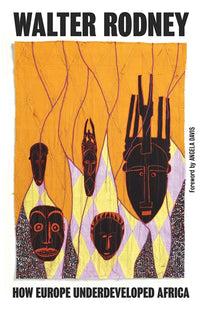 How Europe Underdeveloped Africa is an ambitious masterwork of political economy, detailing the impact of slavery and colonialism on the history of international capitalism. In this classic book, R...
Book strip #3
-

My Country, Africa
with Jean Mackellar
Epilogue by Eve Blouin
Foreword by Adom Getachew and Thomas Meaney
Andrée Blouin—once called the most dangerous woman in Africa—played a leading role in the struggles for decolonization that shook the continent in the 1950s and ’60s, advising the postcolonial lead...
