
Stonewall Riots
STONEWALL RIOTS. The Stonewall Riots – also referred to as an “Uprising” or “Rebellion” – are perhaps the most widely known event in LGBTQ history, familiar enough that President Barack Obama made reference to it in his 2013 Inaugural Address. But Stonewall proved to be much more than a memorable event. It is commonly recognized as sparking the birth of a radical gay liberation movement. It is commemorated each year on the last Sunday in June with marches and parades that bring millions of people together onto the streets of cities across the globe.
In the early morning hours of Saturday, June 28, 1969, New York City police raided the Stonewall Inn on Christopher Street in Greenwich Village. A popular gay bar with ties to organized crime, the Stonewall attracted a disproportionate number of patrons who were gender-nonconforming as well as street youth abandoned by their families.
Bar raids by police were common practice in New York and other cities in this era. But this time, as police were expelling patrons and placing some under arrest, a crowd formed on the street and began shouting at police. When a lesbian resisted the attempt to place her in a police wagon, the scene exploded. The crowd began throwing bottles and cans at the police, who retreated into the bar. Soon bricks and rocks were being flung, and a garbage bin was set on fire and pushed through the smashed window of the Stonewall Inn. Police reinforcements arrived, and the crowd dispersed, rushing through the streets of Greenwich Village.
Word of the rioting circulated quickly, and on Saturday night, a large crowd spontaneously gathered outside the closed Stonewall Inn. “Gay Power” had been chalked on the sidewalk and the building wall, and by midnight, a crowd estimated at 2,000 was shouting slogans like “We Want Freedom Now” and “Christopher Street Belongs to the Queens” as they marched through the neighborhood. Demonstrations continued the following night as well, and after a long article appeared in The Village Voice on Wednesday, another night of street rioting occurred.
By the end of July, inspired by the rioting, activists in New York City had formed a group called the Gay Liberation Front (GLF). Drawing on the name of the National Liberation Front in Vietnam, GLF echoed the revolutionary rhetoric of the New Left, the Black Power Movement, and radical feminists. In its statement of purpose, GLF declared itself “a revolutionary group of men and women formed with the realization that complete sexual liberation for all people cannot come about unless existing social institutions are abolished.” It described the institution of marriage “as one of the most insidious and basic sustainers of the system. The family is the microcosm of oppression.”
During the 1950s and 1960s some gay men and lesbians had come together in what they described as a “homophile” movement. But it remained small, of marginal influence, and largely invisible to most LGBTQ people and most Americans. By contrast, the gay liberation impulse, inspired by Stonewall, spread rapidly. Most members of GLF in New York were young and deeply influenced by the radical protest movements of the 1960s. They appeared, for instance, with gay liberation banners at the national antiwar march held in Washington, D.C. in November 1969 and at Black Panther Party rallies.
At the same time, Stonewall and the formation of GLF were widely covered by underground and alternative press outlets. The East Village Other announced that “revolution is being heard on Christopher Street” while the Berkeley Barb wrote that “homosexuals took to the streets in New York City and joined the revolution.” Thus, the Stonewall riots and the formation of a radical LGBTQ group in New York City quickly became known to a much larger set of younger, already politically radicalized, LGBTQ people.
Versions of GLF rapidly appeared in cities and college towns across the United States. By 1973, the number of movement organizations had grown from barely fifty on the eve of Stonewall to over 800. Particular constituencies within the LGBTQ population came together in autonomous organizations as well. New York, for instance, spawned Radicalesbians, Third World Gay Revolution, and Street Transvestite Action Revolutionaries. These organizations also adopted a radical stance toward social, cultural, and economic structures. Third World Gay Revolution, for instance, declared that “our main enemy is the socio-economic-political system of capitalism and the people who make profits off our sufferings . . . We want the abolition of the institution of the bourgeois nuclear family . . . We want a new society – a revolutionary socialist society.”
In the months and years immediately following the Stonewall Riots, these groups engaged in a variety of militant actions. They disrupted the public appearances of elected officials, protested police harassment, and challenged the discriminatory policies of many gay bars that were designed to keep lesbians and men of color out. They especially targeted media outlets that either ignored LGBTQ issues entirely or reported on them in hostile and offensive ways. Perhaps most significantly of all, this first cohort of post-Stonewall radical activists spread the call to “come out.” Virtually all gay and lesbian individuals at this time kept their identities secret from people in their lives. Many even used pseudonyms when they went to gay and lesbian bars. By contrast, the message that Stonewall inspired in this new cohort of activists was clear: come out of the closet and embrace one’s identity openly and proudly.
Despite their importance, the Stonewall Riots might easily have faded from memory was it not for the decision by some activists in New York to commemorate it with a Christopher Street Liberation Day March, to be held on the last Sunday in June 1970. A couple of thousand individuals marched from Christopher Street in Greenwich Village to Central Park for a rally, where they were joined by thousands of others. Similar events were held that year in Chicago and Los Angeles. Over the years and decades, these commemorations have grown much larger and spread to hundreds of cities and dozens of countries. Although they have often been transformed in more recent years into celebratory parades with little radical political content, sometimes contemporary events intervene so that the angry spirit of Stonewall is revived. This was certainly true in 2020 when the combination of pandemic, economic recession, and outrage over police violence toward African Americans led to more militant demonstrations in many cities. Thus, the Stonewall Riots remain important within the LGBTQ community as a symbol of radical, militant resistance that marked a historical turning point.
Further reading
Carter, David. Stonewall: The Riots That Sparked the Gay Revolution. New York: St. Martin’s Press, 2004.
Duberman, Martin. Stonewall. New York: Dutton Press, 1993.
Stein, Marc, ed. The Stonewall Riots: A Documentary History. New York: New York University Press, 2019.
“Stonewall Uprising” PBS Documentary. June 2020. American Experience.
Book strip #1
Book strip #2
-
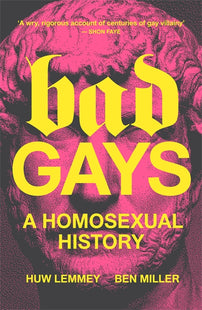
Bad Gays
by Huw Lemmey and Ben Miller
Too many popular histories seek to establish heroes, pioneers and martyrs but as Huw Lemmey and Ben Miller argue, the past is filled with queer people whose sexualities and/or dastardly deeds have ...
