From the Archives: How They Beat the Miners
Originally published in 1995, Verso author Paul Foot reviews Seumas Milne's The Enemy Within

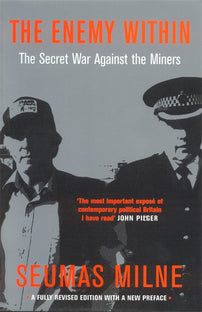
With the forthcoming Inquiry on the Battle of Orgreave, we've dug out Paul Foot's review of Seumas Milne's The Enemy Within: The Secret War Against the Miners. Originally published in the January 1995 edition of The Spectator, Foot discusses Arthur Scargill, MI5's infiltration of the National Union of Miners and the role of journalism in shaping public support of police repression. With characteristic sharpness, he highlights the revelations brought to light through Milne's best-selling book, exposing just how far the British intelligence machine is willing to go to silence political dissent.
***
This is a book about spies. Since its author is a journalist at the Guardian, it will be of special interest to readers of The Spectator, which has recently been celebrating a great spy scoop. The Spectator exposed a senior journalist at the Guardian who took a few trips abroad more than ten years ago to meet officers of the KGB. Seumas Milne deals with an altogether more trivial matter. He suggests that spies paid for by the British security services helped to break the biggest industrial dispute in postwar British history, with the specific intention of annihilating one of Britain’s strongest and most democratic trade unions.
Milne’s specific target is the ‘story’ which broke simultaneously in March 1990 on the front page of the Daily Mirror and on Central TV’s celebrated Cook Report. The main thrust of the story was that the President of the National Union of Mineworkers had, at the peak of the great miners’ strike in 1984, received in his office £163,000 in cash from Libya, ‘a large chunk’ of which he used to ‘pay personal debts’ – including his own mortgage and the home loans of two officials, the NUM general secretary Peter Heathfield and chief executive Roger Windsor.
This was indeed a remarkable story. During the miners’ strike and since, despite his re-election as President, Arthur Scargill had earned himself the intense hatred (mingled with fear) of every media baron in the country. Yet in all the mountains of abuse heaped on his head in the nine years of his Presidency, no one has ever suggested that he was personally corrupt. Arrogant, offensive, narrow-minded, inflexible, wilful – all this with knobs on. But personally corrupt, unthinkable. The Mirror/Cook story sought to remove from Scargill his most precious quality: his ferocious integrity. For the first time, the solidarity and support he enjoyed among miners in general and Yorkshire miners in particular wavered. If their President had been salting away cash which was donated to the strike ‘to pay personal debts’ then perhaps there was something in what the media had been preaching at them all these years.
[book-strip index="1"]
Seumas Milne has subjected this story to one of the most remarkable demolition jobs ever committed to hard covers. The central Mirror/Cook allegations do not take him very long. When the ‘Libyan money’ is said to have arrived, Scargill did not have a mortgage to pay. He had paid it off from his own savings several months previously. Heathfield did not have a home loan either. His home was owned by the union. There was only one person whose mortgage had been paid off by the ‘Libyan money’: Roger Windsor, the union’s chief executive. He promised to pay the union back for the loan, but has never done so.
This is especially odd, since Windsor plainly had the funds to pay back his union. Shortly before the Mirror story broke, the paper, then owned by Robert Maxwell, a man not best known for his probity, paid Windsor a fantastic £80,000 for making against his former President and general secretary entirely false allegations which were true only to himself. I worked for the Daily Mirror for thirteen-and-a-half years – including the so-called ‘slush years’ of the early 1980s. I cannot recall a source for a serious news story being paid anything like £80,000.
On top of this, the Mirror shelled out £50,000 to Jim Parker, Scargill’s once-devoted bagman and driver. I remember Jim driving Scargill to my home soon after the strike. He sat in my front room for more than an hour, embarrassing me with eulogies of his great leader. Jim Parker had nothing to add to Windsor’s story. Well, not quite nothing. He alleged that Scargill’s claim to have been hit over the head by a policeman during the mass picket of the Orgreave coal works was untrue, and that Scargill had fallen down a bank and hit his head on a sleeper. This allegation – considered inside the Mirror when the story was brought as the ‘strongest’ in Jim Parker’s repertoire – was not published. For that I claim some small responsibility. When I saw the story in type before publication I pointed out to the editor, Roy Greenslade, that in 1984 I had gone to Orgreave to meet a large group of miners, all of whom, from different vantage points, had seen Scargill being hit over the head by a policeman’s baton, and at least two of whom had photographed the incident. The photographs and the witness statements had been published on the front-page story on the say-so of Jim Parker, even justify a payment of £50,000? No, Greenslade decided. The story was pulled. But it appeared in all its glory on the Cook Report without a protest or even question from the great investigator.
Seumas Milne does not stop at exposing these simple falsehoods and the vast payments for them. He goes on to prove beyond any doubt that the money raised by Libyan trade unions to support the miners’ strike could not have been the money which Mirror/Cook alleged was parcelled out by Scargill in his office on 4 December 1984. Scargill was not even in his office this morning, for a start. Much more crucially, the Libyan trade union money was sent through the banking system, not in cash as the Mirror/Cook report alleges. After careful study of documents provided him by the union and by the Libyan government, Milne demonstrates that Windsor brought in the cash on 29 October 1984, not 4 December, and that documents had been forged to prove the later date. He asks this question: if the Libyan money went through the banking system, where did the cash which Windsor brought to Scargill’s office five weeks earlier come from? Milne can’t answer the question, but it helps his surmise that an MI5 mole was planted at the National Union of Miners, with no expense spared.
[book-strip index="2"]
Though it has sold remarkably well, it is meticulously argued and beautifully published, the book has been greeted with an embarrassed silence by important journalists and their proprietors. If Milne had made any serious mistakes, he would have been denounced by the same pack which savaged Scargill. But now the hounds know as well as the huntsmen that the Scargill witch-hunt systematically breached even the most elementary journalistic rules. Every conceivable agency of the state did their best to follow up on the Mirror/Cook story and hold Scargill accountable for the corruption they alleged – the Serious Fraud Office, the Trade Union Certification Officer, the Inland Revenue, the receivers and sequestrators, Mr Gavin Lightman OC, his solicitor chum Bruce Brodie and his accountant chum Michael Jordan – all strained every muscle to prove Scargill corrupt, and all have limped from the field, grudgingly conceding that everything Scargill did had one purpose only: to win the strike and to save his union and his industry from the ruin which would certainly engulf them if the strike was lost.
Despite the miners’ great battle, the strike was lost, and the industry and the union have almost gone; but not before Arthur Scargill won back the solidarity and support of those who fought with him to save both. In the journalistic silence, is there even a single voice raised in apology? Roy Greenslade has publicly conceded that the Mirror story may well have planted on him by intelligence. But what of the celebrated Roger Cook and his producer Clive Entwhistle? What of those responsible for the British Press Awards, Tony Loynes of the UK Press Gazette and David Chipp? What have they to say about their award for a story whose central facts were demonstrably false, and which was brought with one of the highest payments in the foul history of chequebook journalism? And what is there in store for British journalism if it can be so dramatically demonstrated that such a high-profile story was probably planted, and that no one gives a damn?
Book strip #1
-
 30% off
The Enemy Within
-
 30% off
The Shadow of the Mine
-
Book strip #2
-
 30% off
The Populist Moment
-
 30% off
The Starmer Project
-