The Counterrevolution Against 25 January
On the anniversary of the 2011 Egyptian Revolution, journalist Hossam el-Hamalawy discusses its legacy and the impetus for his forthcoming Counterrevolution in Egypt.

Anti-Mubarak protesters march through Nasr City, east Cairo, 29 January 2011. Photo by Hossam el-Hamalawy.
Every year, the anniversary arrives accompanied not only by ritualised remembrance, but by denunciation. Official media and regime publicists do not treat 25 January 2011 as a moment of collective courage or political possibility. They treat it as a crime. As a foreign conspiracy. As a plot to bring down the state, fracture the nation, and open the gates to chaos.
In this telling, the revolution is not a demand for bread, freedom, and social justice. It is an act of treason retroactively discovered. A pathology to be diagnosed and eradicated. A warning story deployed to discipline the present.
That vilification is not incidental. It is foundational.
For more than a decade, the regime has waged a systematic campaign to delegitimise 25 January, to strip it of political meaning and recode it as a security threat. Archive footage is recycled not to remember, but to prosecute. Language is weaponised to turn revolt into sabotage and dissent into an imported disease. The point is not historical debate. It is deterrence.
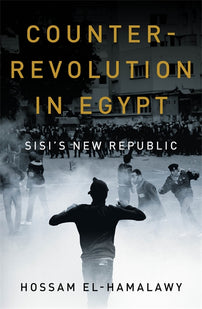
My new book, Counterrevolution in Egypt: Sisi’s New Republic, begins from this reality. It treats the revolution not as a closed chapter, and not as a romantic failure, but as an event that terrified the state deeply enough to force it to reinvent itself. What followed was not merely repression, and not a return to the old order. It was the construction of a new one: a regime built around the permanent anticipation of revolt, and around the conviction that the people themselves are the enemy.
This book is not a eulogy for a lost moment. It is not an exercise in nostalgia, and it does not seek consolation in moral clarity alone. It is an attempt to understand how power reorganised itself in the face of mass revolt, and why that reorganisation has proven so resilient.
The central argument is simple, and often avoided: counterrevolution is not improvisation. It is not panic. It is not merely reaction. It is planning, coordination, institutional learning and the systematic closing of political space.
To grasp this, the book takes the Egyptian security sector seriously as a set of institutions with histories, rivalries, doctrines and internal logics. The military, the police, and the intelligence services are not treated as a single, seamless monolith. They are competing bodies, each with its own ambitions, budgets and claims to authority. What the revolution did was force these rival institutions into an alliance against a common threat.
That threat was not a party, or a faction, or a foreign hand. It was the sudden collapse of fear.
Before the Uprising, Fear Was Ordinary
Long before 2011, Egypt was governed through a dense web of everyday coercion. Violence did not announce itself only in moments of emergency. It seeped into ordinary life: police stops, arbitrary detention, routine humiliation, and the omnipresent threat of torture in police stations that functioned less as institutions of justice than as laboratories of subjugation.
Torture was not exceptional. It was disciplinary. It enforced hierarchy and reminded citizens of their place. It also followed a clear social pattern. Those without wealth, connections, or protection were its most frequent targets. Repression was not evenly distributed. It was targeted, routinised, and normalised.
In this system, the police were not merely enforcers of the regime’s will. They were political actors in their own right, junior partners in a ruling coalition, invested in maintaining a social order built on fear. The Interior Ministry’s authority was not abstract. It was intimate, physical, and daily.
What 2011 exposed was not simply discontent, but vulnerability. When crowds overwhelmed police lines, when stations burned, when officers retreated, the myth of invincibility shattered. The revolution did not just challenge power. It revealed how brittle that power could be.
[book-strip index="1" style="buy"]
When the Street Became Ungovernable
The uprising did not erupt out of nowhere. It was preceded by years of labour unrest, localised revolts, and sustained anti-torture campaigns. Workers had learned to strike. Activists had learned to document abuse. Grievances accumulated faster than the state could absorb or deflect them.
By late 2010, the regime faced a society in motion. The call for protests on 25 January provided a focal point, but it did not create the anger. It gave it form.
On 28 January, the Friday of Rage, the Interior Ministry lost control of the streets. The withdrawal of the police was not tactical. It was forced. For a brief moment, the regime’s primary instrument of everyday fear ceased to function.
The response to this humiliation was not reform. It was memory. The security apparatus remembered what it felt like to lose control, and it resolved never to experience it again.
Counterrevolution as Process, Not Moment
One of the book’s core interventions is to reject the idea that counterrevolution can be reduced to a single event: a coup, a massacre, a decree. Counterrevolution is cumulative. It unfolds through law, bureaucracy, personnel decisions, and institutional redesign.
In the period immediately following Mubarak’s fall, the security sector was reshuffled, not dismantled. Officers were transferred, promoted, or quietly retired. Accountability was deferred. Files were buried. The machinery remained intact, waiting for conditions to change.
The struggle over the archives of State Security Investigations, Mubarak’s fearful secret police, in March 2011, revealed the stakes clearly. What protesters demanded was not symbolism. It was exposure. What the security apparatus defended was not paperwork, but immunity.
This was the counterrevolution in its early phase: cautious, fragmented, but already oriented towards restoring control over memory, documentation, and narrative.
The Second Republic and the Politics of Revenge
After 2013, repression was no longer tentative. It became expansive, coordinated, and unapologetic. The alliance between the military, police, and intelligence services hardened into something more durable than convenience.
Violence was no longer justified as exceptional. It was normalised as governance.
There was also an affective dimension to this transformation that is often ignored. Revenge mattered. The police remembered 2011 as an insult. Authority had been mocked, uniforms burned, officers chased from neighbourhoods they once dominated. The counterrevolution was not only strategic. It was emotional.
Massacres became rituals of restoration. Impunity became a guarantee. The message was unmistakable: the price of challenging the state would be collective, spectacular, and final.
This was the founding logic of the “Second Republic”. Not a restoration of Mubarak’s order, but its mutation into something more aggressive, more centralised, and less constrained by pretence.
A Colonial State Without Colonisers
To understand the nature of this new order, the book draws on arguments advanced by historian Khaled Fahmy and political sociologist Aly Elraggal: that Egypt has come to resemble a colonial state without foreigners. The military and security agencies function not simply as powerful institutions, but as an occupying structure embedded across civilian governance.
Senior officers sit inside ministries. Civilian bureaucracies operate under security oversight. Economic planning, urban development, and local administration are all subjected to a logic of threat assessment. Politics is not managed. It is pre-empted.
This framework helps explain why repression extends far beyond prisons. It shapes cities, neighbourhoods, and public space. It determines who can assemble, who can speak, who can organise, and who must ask permission simply to exist without harassment.
The revolution’s slogans were not utopian. They were diagnostic. The counterrevolution’s response was equally clear: the people are not citizens to be served, but risks to be managed.
[book-strip index="2" style="buy"]
From Policing Protest to Engineering Society
Counterrevolution does not end with the crushing of demonstrations. It continues in zoning laws, licensing regimes, demolitions, and surveillance infrastructures. The book traces how security oversight has been woven into civilian ministries and everyday administrative processes.
Ordinary economic activity can be suspended under the rubric of security approval. Neighbourhoods are cleared and rebuilt not only for profit or spectacle, but for control. Public space is redesigned to prevent congregation, movement, and unpredictability.
This is not accidental. It is counterrevolution as environment.
A regime that fears the return of mass politics does not rely on force alone. It reshapes the terrain so that collective action becomes difficult, risky, and socially isolating.
Another persistent error in writing about Egypt is to treat repression as a purely technical function. The security sector is not merely repressive. It is political.
Its agencies compete for influence, jurisdiction, and resources. They expand their mandates, cultivate international partnerships, and deploy global counterterrorism language to justify domestic control. Surveillance becomes policy. Emergency becomes routine.
This matters because it reveals why reform is structurally impossible within the existing framework. A system built on coercion has incentives to reproduce coercion. Fear is not a by-product. It is an asset.
Reading on 25 January
Anniversaries are often used to tame history. To turn rupture into ritual, and trauma into closure. My book is a refusal of that taming.
It rejects the idea that the revolution failed because it was naïve, premature, or insufficiently disciplined. It insists instead on examining how power adapted, learned, and reorganised itself to prevent a recurrence.
Understanding counterrevolution is not an exercise in despair. It is a refusal of myth. It is a commitment to clarity about what we are up against.
The regime has invested enormous effort in teaching society that revolt leads only to ruin. The least we can do is refuse to accept that lesson unexamined.
Preorder, Read, Circulate
A final word, without euphemism.
If what happened in Egypt matters to you as more than a regional tragedy, if you recognise in it a global lesson about how states respond to mass politics, then this book is for you.
Preordering is not a consumer gesture. It is a way of amplifying work that insists the counterrevolution has structures, budgets, doctrines, and international partners. It is a way of supporting analysis that refuses the language of “stability” and names violence as governance.
On 25 January, the revolution does not need memorials. It needs readers who refuse consolation and demand understanding.
Preorder the book. Read it. Argue with it. Share it.
The counterrevolution has spent fifteen years perfecting its methods. It would be obscene to respond with silence.