Orgreave Victory: Time for Answers
Morag Livingstone outlines how the UK government’s forthcoming Inquiry into the 1984 Orgreave clashes marks a long-awaited victory for campaigners.

Image: Miners run from the police, Orgreave, 18 June 1984 ©Martin Shakeshaft
The announcement of a statutory inquiry by this Labour Government is an exciting victory for the Orgreave Truth and Justice Campaign (OTJC) after 13 years of persistent and effective campaigning. In response to the announcement the OTJC said they were, ‘cautiously ecstatic’. Most people, outside of the Conservative Party, seem very pleased with the selection of the Inquiry’s Chair, The Rt Revd Dr Pete Wilcox, Bishop of Sheffield, referred to in the Government’s announcement as ‘Bishop Pete’.
Delivering on a promise included in the last three Labour Party manifestos, the Government confirmed the Inquiry would cover ‘events surrounding clashes at the Orgreave Coking Plant in 1984, causing 120 injuries. In total, 95 picketers were arrested and charged with riot and violent disorder. All the charges were later dropped after evidence was discredited.
The inquiry will be statutory, with the appropriate powers to compel people to provide information where necessary’ and is expected to start in the Autumn of 2025.
It is understood that the Home Office and Government will now stand aside until the Inquiry presents its findings. The final scope of the Inquiry, according to the Parliamentary announcement by Minister for Policing and Crime Prevention, Dame Diana Johnson, will be determined by Bishop Pete. Dame Johnson ‘is very clear that the inquiry should look at the evidence and should hear testimony if that is what it wishes to do. It will do so without fear or favour, wherever the evidence leads it to look.’ Home Secretary Yvette Cooper further intimated Bishop Pete’s freedom in this regard, stating ‘I think the miners’ strike still has deep scars across coalfield communities, and the decisions made at that time – the broadest decisions that were taken by the Thatcher government in the 1980s – the scars can still be felt across the coalfields.’
It seems Bishop Pete, and those appointed to support him will be able to follow the evidence and secure the whole truth. Not just about the policing and subsequent trial but in regards to the extent of the Thatcher Government’s role. What remains a serious concern is the revelation that documents directly relating to Orgreave had been destroyed by Northumbria police just before Labour came into office. As well as asking for information on any destroyed documents, Home Secretary Cooper ‘recently wrote to all police forces in England and Wales and all Government Departments to remind them […] that information relating to the events at Orgreave on 18 June 1984 be retained … [and that] it is a criminal offence to destroy or conceal information relevant to a public inquiry.’
While some of the evidence held by relevant parties, the National Archive, the ACPO Archive in Hull and in the basements of police buildings will be identifiable by a search key ‘Orgreave’, it is my experience that files relating to what happened at Orgreave are not always so obviously named or referenced. As I am sure the Hillsborough Inquiry found, a more nuanced troll will be necessary if the Inquiry is to uncover the true extent of government intervention in the miners’ strike and the policing of Orgreave.
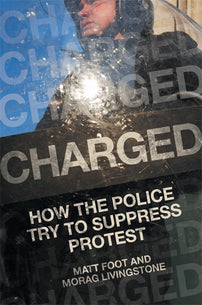
During the strike the Thatcher Government publicly stated ‘non-intervention’. While many have always known this as untrue, we confirm in Charged: How the Police Try to Suppress Protest that behind the scenes there is evidence across numerous government files and meeting minutes of a very different story.
[book-strip index="1"]
To fully understand what happened at Orgreave on 18 June 1984 it is thus important that we go back to the 1980s - when police power stepped up a level and breached the line of operational independence. The extent to which the Thacher Government both conspired with others and lied to parliament, the media and the public will hopefully be resolved by the Inquiry - particularly in regards to the operational independence of the police, a UK doctrine that reflects the separation of power – vitally important in a democratic society.
From 1981, the Government actively enacted the Ridley Plan created in opposition by the Conservatives. This plan explored how to provoke and win industrial disputes in nationalised industries, paving the way for market forces and capitalism. In relation to policing, this 1977 plan determined ‘to have a large, mobile squad of police who are equipped and prepared to uphold the law against the likes of the Saltley Coke-works mob’.
Thatcher’s belief in government interference in policing operations started before she became prime minister. In 1979, while in opposition, she had a spat with the then Labour home secretary, Merlyn Rees – an argument detailed in the Orgreave chapter of Charged. Thatcher firmly believed that ‘chief constables should be given advice about what they should be doing.’ Three months of correspondence ensued, with the home secretary finally giving a sharp retort: ‘It is fundamental to our system of Government that the Home Secretary does not interpret the law to the police or interview in the operational responsibilities of Chief Officers.’ In power, Thatcher’s mind was unchanged. Piecing together the research we can now prove that Thatcher asked her own government as early as 1981 to secretly plan how they could withstand a coal strike.
At the same time, following the 1981 Brixton Riots, Thatcher’s Home Secretary William Whitelaw commissioned the Scarman review. Lord Scarman’s report recommended more colligate community policing of protest. While publicly Scarman’s review and recommendations were welcomed, behind closed doors the Home Office instigated a very different approach, part of which came to light during the 1985 trial of the first 15 miners indicted with riot and unlawful assembly on 18th June 1984 at Orgreave (95 miners in total were charged and the remaining 80 awaited their trials).
As we cover in the Introduction to Charged a ‘secret’ police manual drawn up by the Association of Chief Police Officers in conjunction with the Home Office came to light during the trial when Assistant Chief Constable Clement, the officer in charge at Orgreave let slip the police were adhering to a manual of tactics. What came to be known in the Orgreave trial as the ‘ACPO Manual’ was a 500-page classified document including paramilitary tactics that changed the manner in which UK police operations at protest were conducted.
The 1985 trial only disclosed some pages of the manual. The contents angered Tony Benn, prompting him to seek ‘an immediate debate in Parliament on the manual which had never been discussed by members of Parliament. Benn was highlighting that potentially unlawful police tactics had been endorsed without Parliament’s knowledge.’ (Charged, p3)
While Parliament was unaware of this shift in policing the Home Secretary’s Office were very worried that the manual, Home Office involvement and the Home Secretary’s secret endorsement of such draconian measures to deal with protest would ‘one day’ become public – they even prepared a statement for when it did. The Tactical Options manual has never been fully disclosed. Home Office involvement in the creation of the Manual, and the fact that the home secretary signed it off without referring to Parliament has also never been acknowledged.
Its existence and content were approved by the Home Secretary, Willie Whitelaw. Not only was the public unaware of it, so were Parliament and the rank and file of the police. We believe Thatcher was aware of it, something we think the Orgreave Inquiry should investigate.
The Home Office of 1983 thus handed the police licence to prioritise these brutal powers over Scarman’s more colligate recommendations. Following the unrest and ‘riots’ in cities across the UK in 1981 it gave the green light to paramilitary policing and tactics. The manual was first utilised at the printing dispute in Warrington in 1983, (Charged: Chapter 1. The Guinea Pig: The Messenger Printers, Warrington, 1983) where the police ordered the media present to turn off their lights before the police unleashed extreme violence, snatch squads and even driving their vehicles at striking workers and protestors. It was the testing ground for the new manual and whilst a public inquiry was called for into the actions of the police that night, it was refused.
On 18 June 1984, at Orgreave, the police used short shields and truncheons together for the first time in the UK. This was a new tactic set out in the manual that permitted use to ‘incapacitate’ people just for being there, far beyond what Ridley had envisioned. In Charged we investigate the impact of the Manual over 40 years, through a number of mass protests that turned violent. We tell the troubled history of the relationship between police and protesters and reveal organised police violence not only at Orgreave, but against those protesting against racism, unfair job losses, draconian laws, or environmental disaster including Stonehenge, anti-poll tax campaigners, student protests and the Black Lives Matter movement.
In our chapter in Charged ‘Maggie’s UK War: The Miners, Orgreave 1984’, we piece together evidence including court documents, government files placed in the National Archive, articles, eye-witness testimony and the 2015 IPCC Review, to establish that not only is ‘non-involvement’ by the Thatcher Government a falsehood, but also that ‘there are at least two areas of government where preplanning for the strike and micromanagement during the strike happened contrary to statements made to the public and in Parliament at the time.’ These are also set out in the report Orgreave Truth and Justice, 40 years on The Case for an Inquirycovering actions by the by the Thatcher Government during the 1984-5 strike and prior to it.
The tactical options manual that was created in the early 1980s behind closed doors with involvement by the Home Office shows what can be affected when ministers act without impunity — and over time normalised.
[book-strip index="2"]
In 1984, miners weren’t expecting the horses to charge into them — today for protesters it seems to have become a normal recurrence. The crucial shift in public order policing introduced without Parliamentary scrutiny and applied at Orgreave opened the door for the police to go beyond a ‘traditional method of policing’ (Charged p5) with impunity during the miners’ strike and after. Some of the tactics like horse charge, shields and dogs are still applied today. However, the established police and government narratives of police independence remain.
The extent of government involvement in the policing of the miners’ strike is highlighted by the establishment of a secret biweekly meeting called MISC 101. Created in the first week of the strike and chaired by Thatcher, she micromanaged the strike and interfered in the policing of it. (Charged, Chapter 2). The National Reporting Centre (NRC), publicly declared as a logistic co-ordinator, had another role: spying on those fighting for their jobs. This intelligence was passed to the Home Secretary who reported back to the Prime Minister at the MISC 101 meetings. (Charged, Chapter 2).
While such research can give the Inquiry a head start, fuller disclosure will help go further to right the wrongs of the past and influence the future behaviour of public officials. An inquiry that considers in full, government and police action in relation to events at Orgreave, 18 June 1984 is essential. Those impacted by events at Orgreave deserve the hidden truths of police, civil servants and government to be examined properly to ensure that, within their lifetime, the miners get truth and justice. Only then can the public be assured that the Manifesto promise that ‘the truth about the events at Orgreave’ have truly come to light and lessons learnt.
Book strip #1
-
 30% off
Charged
-
 30% off
The End of Policing
-
 30% off
Police
Book strip #2
-
 30% off
Crowds and Party
-
-
 30% off
Riot. Strike. Riot
